
For Kathryn Nowotny, the path to studying health and criminal justice began on a crisis hotline. She worked directly with vulnerable populations, testifying for children in court and providing crisis intervention services, and soon realized she wasn’t cut out for the traditional approach.
“I quickly realized I wasn’t built for it,” said Nowotny, an associate professor of medical sociology at the University of Miami College of Arts and Sciences and director of the Miami Health and Justice Lab.
She eventually took a job at a research center, which shifted her perspective.
“I discovered that most people we incarcerate have been subjected to violence, trauma, and abuse,” she said. “We’re essentially criminalizing trauma.”
That insight changed everything for Nowotny. She began to see incarceration not just as a legal issue, but as what researchers call a “social determinant of health”—something that affects people’s wellbeing just like having access to a doctor or clean drinking water.
When 72 hours changes everything
Nowotny’s research reveals how even brief encounters with the criminal justice system can trigger cascading health consequences. One of her current projects highlights just how quickly incarceration can throw a life off course. Even a short jail stay for 72 hours can start a domino effect.
“When you go to jail, it’s not free,” Nowotny explained. “They charge you intake fees, defender fees, pharmacy and medical costs. But beyond the financial burden, there’s the social stress, the physiological toll on the body from chronic stress, which can lead to shorter life expectancy.”
The ripple effects extend far beyond those three days as employment disruption, loss of health insurance, and housing instability are all factors that can derail someone’s reentry into society.
From big data to community voices
What sets Nowotny’s work apart is her dual approach: analyzing massive datasets while also spending time talking with formerly incarcerated people in Miami, learning things that data alone can’t tell her. She and her team sit down with people who have been inside Miami’s jails and prisons, listening to their stories about what happened after their release. It’s not the kind of data you can find in spreadsheets.
“The reentry process is chaotic, not supportive,” she noted. Her lab is currently adapting a successful reentry program for Miami, working directly with local groups to create more effective support systems.
Nowotny works closely with local groups like Empowerment Zone Reentry Initiative and Ladies Empowerment and Action Program to carry out intervention studies. It’s not always easy—community groups need help now, while academic research moves slowly.
“All of our studies have impact,” she said, “but intervention studies that directly engage with participants tend to have more immediate effects on people’s lives.”
Looking forward
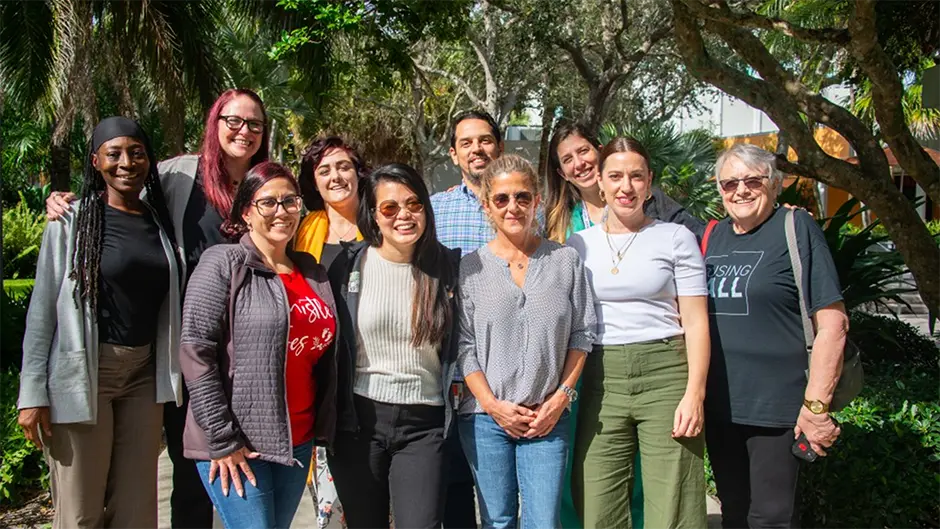
Nowotny’s latest National Institutes of Health-funded study, launched in June, marks another innovative step in advancing health justice. In partnership with local nonprofits through the THRIVE Clinic and IDEA Exchange at the University’s Miller School of Medicine, the three-year project focuses on vulnerable women—particularly those experiencing homelessness and using opioids.
“We’re providing safety planning and helping women recognize red flags around coercion and trafficking,” she explained. “We work with women at different stages of their journeys—some preparing to transition into new circumstances, others still navigating very difficult situations.”
The research team works closely with survivors to develop and test an intervention to help women currently experiencing sex trafficking and women who are the most vulnerable to exploitation through trafficking—an area that has long been understudied.
As discussions around criminal justice reform continue nationwide, Nowotny’s research provides important insights to help shape policy. And while criminal justice reform is a talking point for people across the political spectrum, Nowotny’s research keeps the focus on the lived reality: health outcomes, survival, and the ripple effects on entire communities.