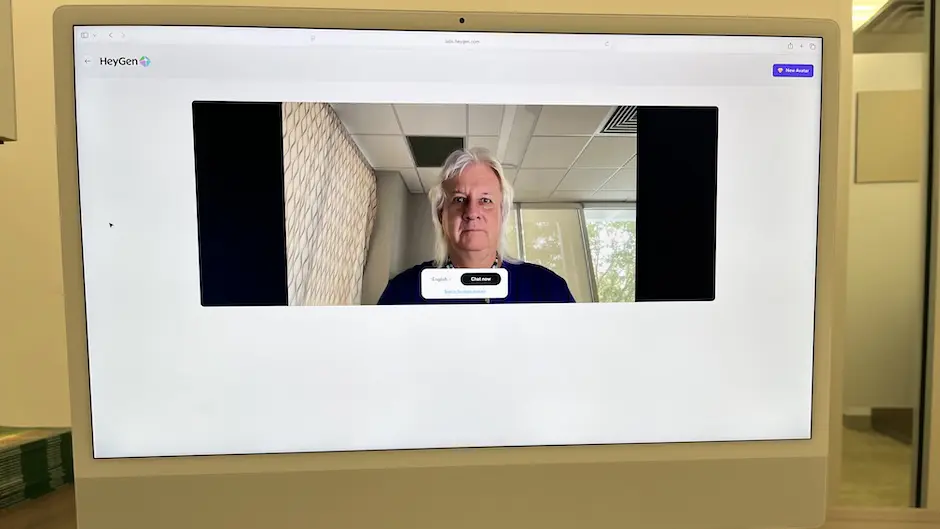
When students walked into Geoff Sutcliffe’s Introduction to Artificial Intelligence course on the first day, they met an unexpected teaching assistant. This assistant looked and sounded exactly like their professor, yet it was available 24/7 and could speak any language.
Sutcliffe, a professor in the Department of Computer Science at the University of Miami College of Arts and Sciences, created an AI avatar of himself to help students navigate the complexities of artificial intelligence. “I showed the avatar to my students during the first lecture, and their reaction was basically, ‘Wow, that’s cool,’” Sutcliffe said. “They immediately wanted to know how it worked.”
For Sutcliffe, the avatar represents more than just another large language model; it’s a window into how AI could change teaching and learning. “Right now, teaching is limited by time and space,” he explained. “You have to be in the same place at the same time, whether it’s in person or on Zoom, and speaking in the same language. An AI system removes those limits. It can be available anytime, anywhere, and because it looks and sounds like a person, students feel more comfortable interacting with it.”

Creating the avatar involved two phases. First, Sutcliffe recorded himself discussing various topics so the AI system could learn his facial expressions and gestures. Then it captured his voice patterns, including his South African/Australian accent (he grew up in South Africa and earned his Ph.D. in Australia, where he lived for over a decade). Behind the digital face is a large language model, enhanced with custom knowledge that Sutcliffe uploaded from his lecture notes. He also gave the avatar specific behavioral instructions: focus on course materials, be friendly, and answer questions using both the lecture notes and general information on AI. “In some ways, it even ‘knows’ more about AI than I do, because it has access to the entire internet along with my own lecture notes,” Sutcliffe noted.
The Department of Computer Science is offering the Introduction to Artificial Intelligence (CSC 345) course for the first time this semester, to students from any discipline. The course provides students with essential AI exposure before they move into more advanced coursework. “The department already had two advanced AI-related courses, but we needed something more introductory,” Sutcliffe said. “Now, AI is part of the core curriculum.”
The course delves into not only the technical aspects of AI, but also the ethical questions created by its growing use. Sutcliffe grappled with some of these questions as he created his avatar.
“Ethics is a huge issue in AI, and it’s only going to become more important in the next few years,” he said. “A big research challenge is figuring out how to formally represent ethics in a computer system. Humans have ethical instincts, but putting those into code is incredibly difficult.”
As for whether AI avatars will change teaching, Sutcliffe sees potential uses for avatars in the long term, especially in undergraduate education. However, he believes human professors remain essential, particularly for research. “One major limitation of current AI is that it doesn’t create truly new knowledge; it only reorganizes existing information,” he explained. “Humans, on the other hand, come up with new ideas through experimentation, creativity, and even randomness.”
For now, however, the avatar serves an important purpose: sparking students’ curiosity about AI.
