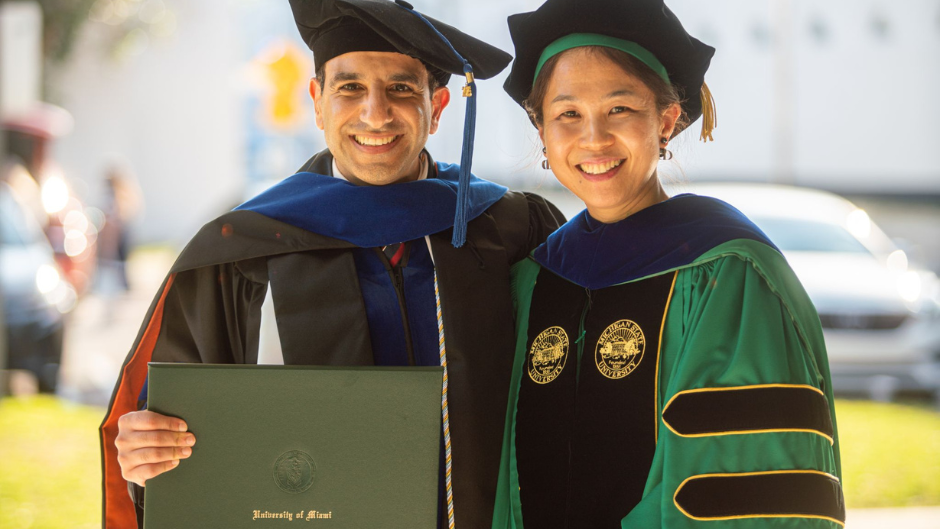
Even before the fall semester began, Soyeon Ahn had already experienced an eventful year. In February, she was one of 25 educational leaders nationwide selected by the American Council on Education (ACE) for its prestigious Fellows Program. Ahn was nominated by Dean Laura Kohn-Wood of the School of Education and Human Development, reflecting the dean's commitment to fostering leadership growth among her team.
In the spring, Ahn traveled to Brescia, Italy with a team of undergraduates for a month-long immersive internship, as part of the school's program in Data Analytics and Intelligence for Social Impact (DAISI), which Ahn launched in 2023.
One of the most meaningful moments, Ahn said, came in May, when the School of Education and Human Development celebrated the first graduating class of the new online Master of Data Analytics and Program Evaluation (MS-DAPE), another program Ahn created.
The inaugural cohort of 12 students included professionals from Microsoft and other tech and media companies, as well as students from education, medicine, and business.
"I'm incredibly proud to see these talented and forward-thinking professionals ready to lead with responsible data-driven decision-making in the real world," said Ahn, who described her MS-DAPE students as among the most engaged and energizing she has taught.
"Their achievements mark a significant milestone in our commitment to advancing responsible data-driven decision-making."
The online master's in data analytics and program evaluation is designed to provide students from various backgrounds with essential expertise and practical experience needed to become data-driven leaders in the workplace.
A key attribute of the program, Ahn said, is that it is intentionally designed for students to succeed without any prior experience in programming or advanced math. In fact, many of her students were drawn to the program unexpectedly after identifying data analysis as a vital tool for growth and innovation in their careers, she explained.
"The program helps many students discover a rewarding career path they never previously imagined," said Ahn, who also teaches in the online doctor of education, applied learning sciences program. "They came into the program because they reached a point where they realized they had a need for better understanding of data.
"Society is evolving so fast that people may become marginalized if they can't contextualize data in their industry to make better policies and practices around it."
As part of the ACE fellowship, Ahn, who has recently published research on the implications of AI-powered tools in educational research, is working on a project funded by the University's Office of Faculty Affairs. The project will use AI to create systems tailored to the individual needs of faculty members.
Ahn said she envisions incorporating AI development into the master's in data analytics program as well.
Through ACE, Ahn will receive training, mentoring, and collaborative opportunities to drive innovation in higher education. As part of the fellowship, she will also work alongside the president and provost at a partner university, learning from the examples of seasoned leaders in a different institutional setting.
She said she sees the ACE experience as having a "natural synergy" with her goals, enabling her to foster a more innovative and inclusive academic environment for all stakeholders, particularly in program development and career opportunities for students.
"I'm excited to take what I gain from the ACE program and bring that back to my students," said Ahn. "The connections with other institutions and industry leaders can be a potential benefit for DAPE and other programs. Our students graduate with marketable expertise and practical experience. The more connections we can offer them to industry the better."
One of her proudest moments with the inaugural cohort in the online master's in data analytics program was witnessing a student choosing a somewhat challenging topic for his capstone project because it was something he was passionate about, instead of choosing a topic that might have been easier.
"When we think about data analytics, you have to have humanity and compassion," she said. "The best data analysts combine creativity and innovation with humanity, compassion, curiosity, and social and emotional intelligence. This was exactly what I was able to see in many of my students this past year."
