After a 35-year career at NASA, Jacqueline Le Moigne has joined the University of Miami College of Arts and Sciences as a visiting professor, bringing her expertise in artificial intelligence (AI), computer vision, and digital twins.
Le Moigne said she was drawn to the University’s strong commitment to interdisciplinary research. “Coming from computer vision and AI, I think it’s essential to do interdisciplinary work,” she said, referring to a subfield of AI that focuses on the ability of computers to analyze and interpret images and videos. “The University of Miami offers great opportunities for that kind of collaboration.”
At the University, Le Moigne is working across disciplines on research related to digital twins, cybersecurity, and distributed spacecraft systems, continuing her mission to advance interdisciplinary research in AI and Earth science. She is collaborating closely with Yelena Yesha, a professor in the Department of Computer Science and the Knight Foundation Endowed Chair of Data Science and AI at the Frost Institute for Data Science and Computing (IDSC).
“Jacqueline Le Moigne is a phenomenal individual,” Yesha said. “There are all kinds of exciting things that she’s been working with us on, and tremendous experience and prestige that she’s bringing to UM.”
Le Moigne’s recent work at NASA focused on digital twins, a sophisticated information system that provides a digital, dynamic, and interactive representation of physical systems. By creating these virtual reproductions of physical systems, researchers can study them and test the impacts of various changes without affecting the actual system.
At the University, Le Moigne is working to create a digital twin of Earth that will enable researchers to study threats facing the planet and the impacts of different interventions. In addition to collaborating with researchers in the Department of Computer Science, where Le Moigne is based, she is working with researchers in other departments and schools, including the Rosenstiel School of Marine, Atmospheric, and Earth Science. Le Moigne will also be part of the AI and Machine Learning program at IDSC, which is led by Yesha.
Le Moigne envisions applications for digital twin technology far beyond Earth science. “In the medical field, digital twins are going to become very important,” she said, describing potential systems that could model entire body functions. “Being able to build a digital twin of the entire body with all the different systems” would help support “treatment options and medical protocols,” she explained.
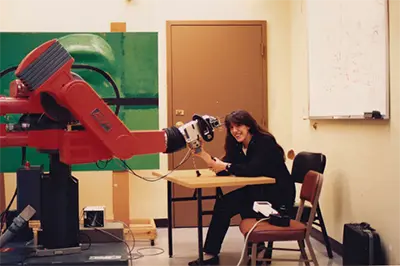
Le Moigne's perspective on AI’s evolution is unique, having earned her Ph.D. in computer science in 1983 and worked on the first autonomous land vehicle in the 1980s.
“I was sure that self-driving cars were going to arrive 10 years afterwards,” she recalled. “Yet it took about 40 years for self-driving cars to become a reality.” This experience shaped her view of current AI capabilities. “I think that AI is very much developed in some specific fields, but we are not yet there in others.”
For students hoping to work in AI, digital twins, or NASA-related fields, Le Moigne emphasized the importance of understanding the application domain, not just the technology. Her Ph.D. at Sorbonne University in France, for example, focused on biomedical imagery.
“I first understood what was the medical problem,” she said. “Then I analyzed what was the optical problem, because the images were taken by multiple types of microscopes, and so I tried to understand how each microscope was working.” This knowledge meant she could properly process biomedical images while taking full advantage of the microscopes’ capabilities.
Le Moigne applied the same approach at NASA, where she rose to become manager of the Earth Science Technology Office’s Advanced Information Systems Technology program and led the development of advanced technologies for Earth science observations. When she arrived at NASA, “the first thing that I did was to sit in a remote sensing class,” Le Moigne recalled, despite her strong computer science background. She believed understanding the problem was essential.
“People develop theoretical solutions that are very good, but that are not adapted to the problem,” she said. “It’s important to be an expert in the computer science field, in the AI and the computer vision field, but being able to adapt the theoretical computer science to the application domain is very important.”