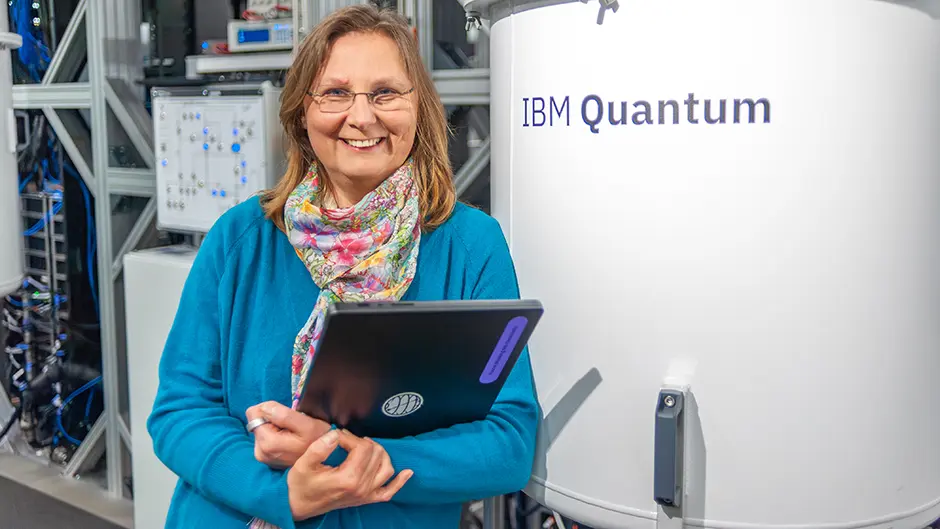
Daniela Bogorin’s path to becoming a quantum research engineer at IBM began in a laboratory much colder than one might expect to find in Miami.
When Bogorin first enrolled as a graduate student at the University of Miami College of Arts and Sciences in 2001 to pursue her Ph.D. in physics, she spent her days working with detectors so sensitive they could measure radiation at the single photon level and had to be kept in near-absolute zero.
Despite Miami’s year-round warm weather, Bogorin “always wore a sweater because the lab was cold,” she said. “And I had to wear closed-toe shoes because I was working with liquid nitrogen and liquid helium.”
Under the mentorship of Massimiliano Galeazzi, a professor in the Department of Physics who is now the department chair, Bogorin spent her graduate years studying highly sensitive detectors used in cosmic X-ray research that function at temperatures colder than outer space.
“That really got me into cryogenic systems and fabrication techniques,” Bogorin said. “When you work in a narrow field of research like cosmic radiation detection, there are few research groups in the world developing them. It is a very tight and great community of researchers. However, they actually belong to a larger family of single photon detectors and learning the physics, understanding applications and fabrications techniques is a very transferable skill.”
As a graduate student, Bogorin focused on developing transition-edge sensors, learning fabrication techniques used throughout the semiconductor industry. She mastered the techniques of depositing materials on silicon wafers and operating complex cryogenic apparatuses. Bogorin soon discovered just how useful those skills would be in the world of quantum computing, a technology that uses quantum bits or “qubits” to perform complex calculations that would take a standard computer far longer than a human lifespan to complete.
Later, Bogorin accepted a postdoctoral position at Syracuse University, a step that eventually led her to IBM and its growing quantum computing program.
Now, she runs a quantum computing lab at IBM, which focuses on testing the newly developed quantum processors—the heart of a quantum computer. Her day-to-day work is rewarding.
“I am one of the first people that gets their hands on the latest generation of quantum processors my colleagues at IBM develop," she said. "It is very exciting and fulfilling work.”
Bogorin credits several University of Miami faculty members with preparing her for this role, especially Carolyne Van Vliet, an adjunct professor whose theoretical physics courses she loved, and her graduate advisor, Joshua Cohn, a professor of physics and the college’s senior associate dean for research and graduate education.
Although Bogorin no longer works with cosmic detectors, the analytical foundation she built at the University still guides her every day. She often encourages students to think of quantum computing as a deeply interdisciplinary field, one that needs engineers, coders, marketers, and problem-solvers, not just physicists.
At the University, the field of quantum technologies is rapidly growing. The University recently joined the Florida Alliance for Quantum Technology, a collaboration that brings together universities, government agencies, and the private sector with the goal of making Florida a national leader in this field. The College of Arts and Sciences, which is home to more than a dozen faculty members whose research involves quantum technologies, is leading the University’s participation in the alliance.