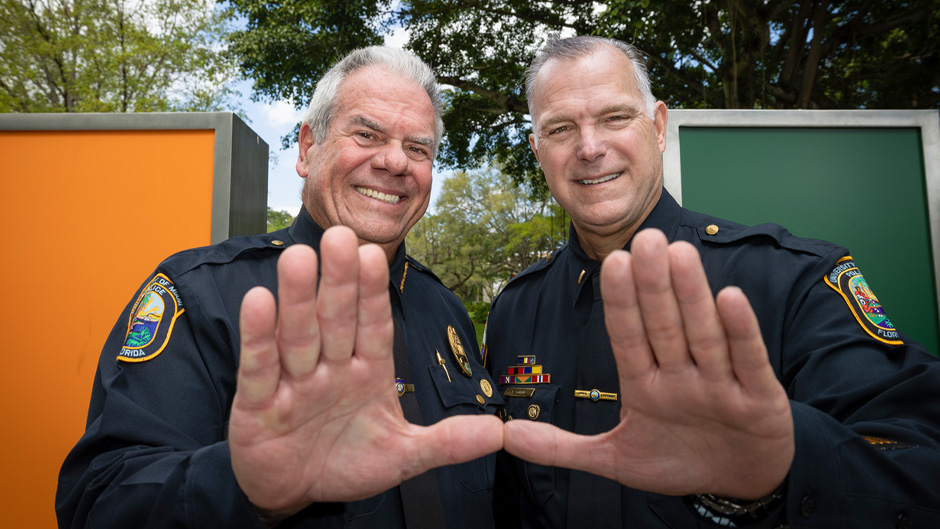
It started with a simple name change. And the exterior of the squad cars that patrolled University of Miami roadways heralded the switch: The Department of Public Safety on the Coral Gables Campus had officially become the University of Miami Police Department.
As simplistic and cosmetic as that seemed, it was only a small part of the myriad changes David A. Rivero implemented when he was tapped 19 years ago to lead the agency charged with the safety and security of thousands of students and employees.
The veteran law enforcement officer, who worked some of Miami’s toughest beats, used modern police practices, innovation, and technology to transform the department, reducing crime on campus to levels never seen before.
“The name change was just the tip of the iceberg,” Rivero recalled. “It was really a change in philosophy, a change in our security mode, a change in the way we did things.”
Now, as he retires as UMPD’s chief of police, there’s one last duty for Rivero to carry out: turning over the reins of the department to a new chief.
Lt. Trevor Shinn, who joined UMPD nine years ago after nearly three decades with the North Miami Police Department, becomes UMPD’s top cop on April 11.
As UMPD transitions to new leadership, both Rivero and Shinn recently reflected on the changes the department has undergone and the challenges that lie ahead.
A new model for policing
“The biggest transition for us was changing our image from public safety to police. ‘We’re police officers,’ I would always say,” Rivero recalled.
That image change included hiring more experienced officers from different law enforcement agencies such as the FBI, the Miami-Dade Sheriff’s Office, Miami Police Department, Florida Highway Patrol, and others. “Having that diversity of ideas and police tactics allowed us to maintain an atmosphere of continuous improvement,” said Rivero, who himself spent 26 years with the Miami Police Department before coming to the University.
At the University, Rivero led the effort to create a robust detective unit, introduced a campus-wide security system of more than 1,000 cameras that operate around the clock, and implemented CompStat, a tool developed by the New York City Police Department that uses data to help police agencies reduce crime and improve performance.
Under Rivero’s watch, UMPD also launched crime prevention programming efforts to address the personal safety and protection of such property as air pods, laptops, cell phones, bikes, and scooters.
Rivero also borrowed a page from professional football, creating a patrol script system modeled after the way many NFL teams script the first few offensive plays to start a game. “Using this idea, our patrol officers start the day knowing where they need to be and at what times based on scheduled events or on crime-mapping data,” Rivero explained.
“We went from having about 350 crimes a year to about 70. The University never saw crime reduction that low in the 50-plus years our department has existed. And those numbers aren’t the result of one person. It’s been a team effort. Everyone chipped in and got behind us to reduce crime,” said Rivero, noting the support of the Coral Gables Police Department, Student Affairs, Parking and Transportation, and Emergency Management.
And the proof is in the numbers. The University, under Rivero’s tenure, has averaged about “two crimes for every 1,000 people in our population, while most of the cities that surround us average as high as 40 crimes per 1,000 people,” he said. “The University made safety one of its top priorities, and that put the burden on us to make sure we kept everyone safe.”
One of the changes Rivero is most proud of was using the University’s split U in the department’s branding. “We put it on our badges, on our uniforms, on our squad cars, on everything, even our letterhead. And it gave us the recognition not only on campus but around Miami-Dade County that we didn’t have before, demonstrating the power of the Univesity of Miami brand.”
Taking the helm
Shinn said he is honored to assume his new role.
“I have big shoes to fill, but we have an excellent team in place and the support of our campus partners and outside police agencies,” Shinn said. “I want to continue that path, but also to look and see how we can improve.
“Whether we’re looking at how we investigated the theft of a scooter, or how we responded to a critical incident, we’ll always ask, ‘How can we do it better?’ I’m going to embrace that,” Shinn continued.
Shinn said the department will continue to ramp up wellness programs for its sworn officers and other employees.
Even before he is sworn in as the new chief, Shinn is already putting his stamp on the department, spearheading the creation of a new campus community relations program called Beyond the Badge, which is designed to augment many of the initiatives implemented by Rivero to improve relationships between UMPD officers and the students and faculty and staff members they serve.
An interactive video, similar to those used to train law enforcement officers in how to deal with certain scenarios, will be the centerpiece of the program. “We want to put the user in the place of an officer or even a dispatcher taking a phone call to allow them to experience what we go through,” Shinn said. “It’ll also allow them to share their perceptions of our officers and will hopefully bridge the gap that sometimes exists between police and the community.”
He brings a wealth experience to his new role as chief of police, leading the department’s uniform patrol and communications divisions. Prior to the University, he served 28 years with the North Miami Police Department, rising to the rank of major.
Shinn was born and bred in the city of North Miami, where he played high school football and was coached by Larry Ball, a former linebacker on the 1972 undefeated Miami Dolphins. Shinn would later coach football himself but went into law enforcement on the advice of many of the police officer parents of the players he coached. “They shared with me how rewarding a career as a police officer was and how it would give me an opportunity to work with youth and give back to the community,” he recalled.
He is proud of the bond he shares with Rivero. Both hold master’s degrees in public administration from the University, with Shinn scheduled to walk in this May’s commencement ceremonies.
As for Rivero, it’s not providing security for the many landmark campus events the University has hosted—such as visits from the likes of President Barack Obama and ESPN’s College Gameday—that he’ll miss most, “but interacting with so many wonderful coworkers,” he said.
He plans to continue teaching a law enforcement class in which he instructs police officers from local law enforcement agencies in police investigation procedures and tactics.
“In a sense, I’ll always wear the badge,” Rivero said. “Police work is in my blood.”
