It’s a tradition that started at some of the oldest universities in the world.
Places like the University of Oxford and the University of Cambridge.
And while the idea of students living and learning with faculty members is not new, it is still rare among colleges in the United States.
Yet, for the past 50 years, the University of Miami has been one of a handful of American colleges and universities that encourage faculty members to live among students through its Residential Faculty program, so instructors can share their wisdom, insight, and expertise with undergraduate students.
“We’re looking to help students feel more comfortable with their academics and to break down the barriers between faculty and students,” said Joy Beverly, senior lecturer of mathematics and chair of the residential faculty team.
This year, the University’s 12-member residential faculty team has one new member living on campus and three new faculty fellows. Faculty fellows are instructors who choose to spend time each week inside residential colleges getting to know students in a different environment, and the role also allows them to apply to live in one of the University’s residential colleges, if there is an opening. The long-standing program is supported by the Division of Student Affairs and the Office of the Provost.
“The real goal is to build an intellectually curious community at the University, and we do that by being more visible to students and offering ways to fuel their curiosity, even in informal conversations,” Beverly added. “We want to be an encouraging academic support network as well as a bridge to the many resources on campus.”
In addition, research indicates that a faculty presence in on-campus housing helps students feel more supported in their new university home and helps them thrive academically.
With that outcome in mind, University of Miami residential faculty host events to get to know students informally and to enlighten them about important topics—like the breadth of opportunities for academic or personal guidance on campus, or even current events. For example, Beverly hosted a brunch in her apartment during the first week back at Pearson Residential College, as well as parent information sessions during move-in. In past years, she organized visits from University Libraries and the Counseling Center to make students aware of their services. Throughout the year, she offers Math Mondays, where students can get help with their homework, along with other programs.

Her colleague Melvin Butler, an associate professor of musicology at the Frost School of Music, offers weekly chess sessions in Mahoney Residential College to teach students one of his favorite hobbies and get to know them at the same time. Once a year, Butler also offers a jam session in his apartment with students in Mahoney who play an instrument.
Last year, faculty fellow Lorella Di Gregorio offered students a window into her Italian upbringing when she served nocciolino—a delicacy of espresso mixed with Nutella and a bit of cream—for a coffee hour each week. The aroma drew students to come chat with her, and their conversations helped her learn new things about the University, too. Later in the year, she organized a program to expand students’ awareness about the sociolinguistic dimension of Spanish in Miami, featuring her colleague professor Andrew Lynch.
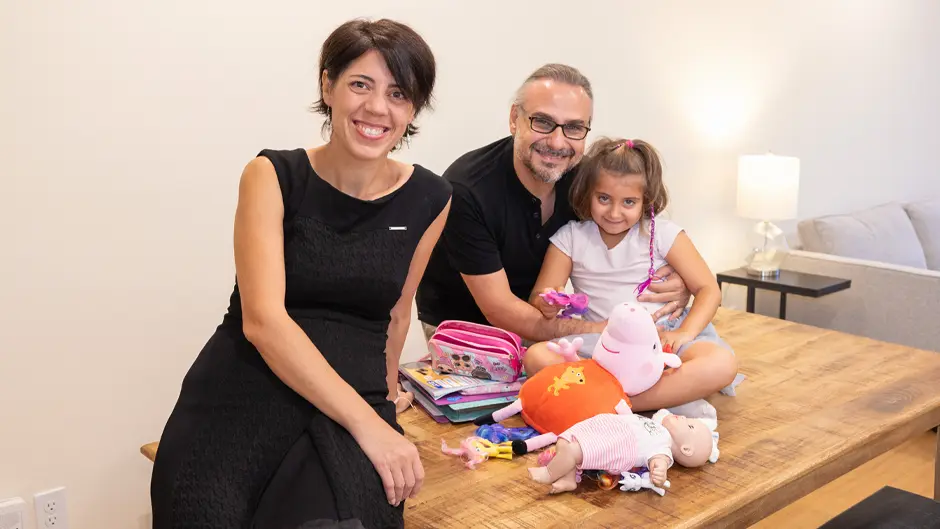
Di Gregorio enjoyed the experience so much that this year, she is moving into Mahoney Residential College with her husband, pianist and esteemed educator Luca Cubisino, and daughter Lara, where she plans to continue serving her signature nocciolinos each week.
“I believe in the transformational potential of residential life,” said Di Gregorio, a lecturer in the Michele Bowman Underwood Department of Modern Languages and Literatures in the College of Arts and Sciences focused on Spanish and Italian culture. “I’ve enjoyed being a faculty fellow for the past two years. It has been life-changing for myself and for the students, so I want to continue to foster this faculty-student connection and create a space where they can be seen, supported, and intellectually inspired.”
Meanwhile, the residential team is also gaining three new faculty fellows this year. Simon Howard, assistant professor of psychology, will be a fellow in Pearson Residential College, while Maria-Cristina Espinoza-Alguera, a lecturer of finance, will be a familiar face in Ibis Residential College. And Shane McFarlane, an emerging novelist and lecturer in Writing Studies, will be a regular visitor at Coral Residential College.
Howard, a social psychologist who studies how race influences judgment, decision-making, and mental health, is looking forward to meeting more students and staff members at the University through his new role.
“I love working with students, and I thought this would be an avenue to work with them in ways that I haven’t yet and to also develop stronger relationships with students that may not come to the psychology department,” Howard said.
Since residential faculty must also plan two programs each year, Howard is looking forward to sharing some of his hobbies with undergraduate students. Outside of his research and teaching, Howard is also a hip-hop artist and practices capoeira, an Afro-Brazilian art form that combines dance, martial arts, and acrobatics. He hopes to bring in one of his teachers for a program at Pearson this year.
“The ways in which you connect with people and change the world are often through education and music, so I do try to merge these interests however I can, and I think there’s a way to bring this into the faculty fellows program,” he said. “I’m excited to join the team, and everyone I’ve met so far has been amazing. There are so many moving pieces in the University’s residential colleges, but centering all of it is the students.”
Any faculty members interested in joining the residential faculty team or becoming a faculty fellow can contact Joy Beverly, chair of the residential faculty, at joybeverly@miami.edu.