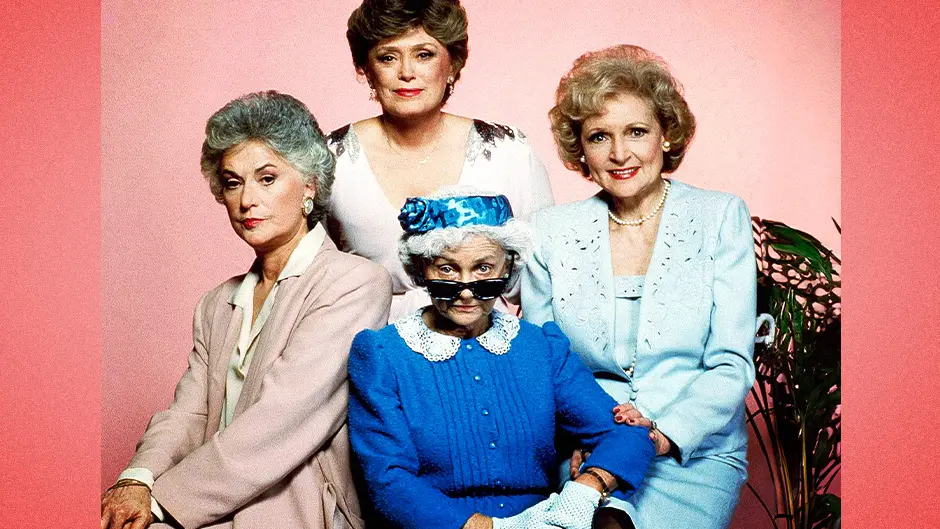
Picture it: Hollywood, Sept. 14, 1985. Bea Arthur, former star of “Maude”; Betty White, honorary mayor of Hollywood and actress known for her work on “The Mary Tyler Moore Show”; supporting actress from “Maude” and “Mama’s Family” Rue McClanahan; and “Torch Song Trilogy” stage actress Estelle Getty premiere in a new show following the lives of four “women of a certain age” who share a home in Miami. The four women navigate life, aging, dating, and all that comes with it. That show was “The Golden Girls.” And this year, the series celebrates the 40th anniversary of its premiere.
“The Golden Girls” was an unlikely candidate for a series in the 1980s. The show premiered just as what became known as the post-network era—or the multichannel environment—began to challenge the dominance of the Big Three networks (ABC, CBS, and NBC) and viewer tastes begin to change amid growing discontent about the blinding whiteness of television produced within the traditional network system.
Yet “The Golden Girls” performed a hat trick that few shows have performed before or since: it truly attracted a strong, multicultural audience. And it did so because it was a queer television show. I do not mean that it was a show that prominently featured LGBTQ representation (although it did, on occasion), but I mean it was queer because a sitcom about four “old” white ladies living in a house together in Miami was strange—especially for television.
Television scheduling practices, particularly in the 1980s, meant that networks attempted to schedule shows with similar tone together in a bid to capture a specific audience segment.
In an era before the remote control and home video recorders were ubiquitous technologies for changing the channel or time-shifting viewing, viewers could sit on their couch and watch an evening of programming on a single network without changing the channel. For example, anyone alive in the mid-1980s will likely remember that Thursday nights at 8 p.m. EST, “The Cosby Show” aired, followed by “Family Ties” on NBC, united by their similar narrative focus on the nuclear family within a comedic mode.
But what would pair with a show featuring four old white ladies? In some ways, the answer was nothing. So NBC dumped “The Golden Girls” on Saturday nights alongside multicultural- and Black-cast sitcoms like “The Facts of Life,” “Gimme a Break,” “227,” and “Amen.” And in placing the series in a seemingly strange television space, NBC inadvertently made a queer series that not only captured a wide-ranging audience but has continued to attract fans long after its initial network run concluded in 1992.
Certainly, women tuned in to watch “The Golden Girls” to see women deal, comedically, with life and love after 50. “The Golden Girls” also, perhaps through Coco, the series’ “gay cook” in the first episode, attracted queer viewers. But even as Coco “disappeared” after the first episode and was “replaced” by Estelle Getty’s Sophia, who tested well with audiences, the series continued to engage with gay- and LGBT-related issues around coming out, marriage equality, and the AIDS/HIV epidemic, as seen in episodes such as “Isn’t it Romantic” (Season 2), “Strange Bedfellows” (Season 3), “Scared Straight” (Season 4), “72 Hours” (Season 5), and “Ebbtide’s Revenge” and “Sisters of the Bride” (Season 6). Perhaps this explains why, when “The Golden Girls” aired on Saturday nights at 9 p.m. EST, gay bars went silent to watch the antics of Dorothy, Rose, Blanche, and Sophia.
But perhaps even more surprisingly, the series attracted a hefty Black audience. Jet Magazine reported that the series was among the top 10 shows in Black households during its second season. Yet, the show did not frequently include Black characters except in episodes such as “‘Twas the Night Before Christmas” (Season 2), “The Housekeeper,” “Old Friends,” and “Mixed Blessings” (Season 3), “Brother, Can You Spare That Jacket?” (Season 4), and “What, Bam, Thank You Mammy” (Season 6).
These Black viewers, as I discuss in a chapter of my book, “Fandom for Us, by Us: The Pleasures and Practices of Black Audiences,” were drawn to the series because of the ways it depicted intergenerational living arrangements and alternative family formations that, while certainly not Black representation, felt relatable to their lives and resonated with their experiences.
For all the laughter, though, “The Golden Girls” was a product of the 1980s. It lived in and responded to discourses about women, aging, and personal finance, among other topics.
While the 1980s was understood as the “Me Generation”—where the acquisition and attainment of wealth was key to achieving the American dream—Dorothy, Rose, and Sophia moved into Blanche’s home not because they wanted to but because they financially had to, gesturing toward the ways living without a spouse/second (or in the case of “The Golden Girls,” a fourth) income was becoming unattainable for the average American, particularly older Americans. It dealt with women’s relationship to menopause (“End of the Curse” Season 2), the difficulties women experience being heard by medical professionals (two-part episode “Sick and Tired” Season 5), sexual harassment (“Adult Education” Season 1; “Feelings” Season 6), and employment difficulties as older Americans (“Rose Fights Back” Season 5).
And in the final analysis, these are the reasons “The Golden Girls” remains relevant 40 years after its network premiere. It reached a wide swath of American viewers across identity categories. And watching the show became a ritual: some Black women recall watching the series on Saturday nights at their grandmother’s homes before going to church on Sunday morning. Queer folks recall watching “The Golden Girls” at bars like Mr. P’s in Washington, D.C., or Sidetrack’s in Chicago during its original run. And Lifetime: Television for Women (and gay men …) cemented the series as a perennial “women’s show” through its exclusive reruns throughout the 1990s and early 2000s.
This coalition of viewers has made “The Golden Girls” feel every bit as relevant and funny as it did when it premiered in September 1985. From pub crawls and pop-up restaurants to trivia nights, fan conventions and cruises, fans continuously proclaim their continued interest in reliving the loves, lives, and laughs depicted in this 40-year-old series. And each night, with “The Golden Girls” playing softly in the background, I thank the series for being a friend that can still rock me off to sleep—40 years later.
Alfred L. Martin is an associate professor and chair of the Department of Cinematic Arts at the School of Communication. Martin co-authored a new book, “The Golden Girls: Tales from the Lanai,” which explores the cultural, industrial, and historical impact of this American sitcom.
