
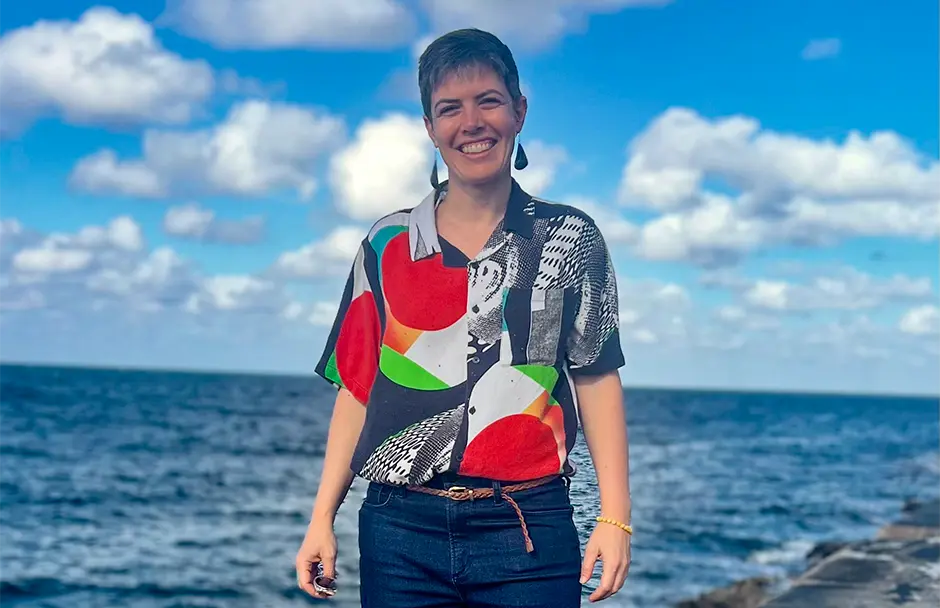
Ruthie Meadows is an associate professor of ethnomusicology at the University of Nevada, Reno, whose groundbreaking work explores how we think about gender, ritual, and sound in jazz—especially within the Cuban context.
Meadows was named a Goizueta Distinguished Presidential Fellow for the Cuban Heritage Collection (CHC) at the University of Miami, and she has spent the fall semester at the Otto G. Richter Library, which houses the Cuban Heritage Collection, doing research.
On Dec. 10, as the culmination of her semester’s work, a special presentation will be held at the CHC called “Cuban Women in Jazz and Fusion,” a conversation with and performance by the musical group OKAN.
At the event, Meadows will be joined by Marysol Quevedo, associate professor of musicology at the Frost School of Music, to discuss the role of women in Cuban Jazz music. The event is open to the public. Those wishing to attend should sign up at: Cuban Women in Jazz and Fusion (Fusión) Tickets, Wed, Dec 10, 2025 at 6:00 PM | Eventbrite
“Dr. Meadows' work as the Roberto C. Goizueta Distinguished Presidential Fellow exemplifies the transformative impact that thoughtful, community-engaged scholarship can have on the Cuban Heritage Collection,” said Amanda Moreno-Schroeder, director of the Cuban Heritage Collection and Esperanza Bravo de Varona Chair. “Her research underscores an underrepresented aspect of the cultural record, and we’re honored to support her project.”
She added: “We look forward to future publications from her research time at the collection and seeing how her work will enrich and advance the documentation of Afro-Cuban women’s contributions to jazz."
Meadows shared more about her work.
What has being named Goizueta Presidential Fellow meant to you?
It has been one of the most incredible experiences of my career. The CHC is the largest repository of Cuban materials outside of the island and the largest repository of Cuban artists materials of the diaspora as well. As an ethnomusicologist who studies gender and Cuban music, it has been an incredible experience for my current project. I am working on my second book, “Experimentalism in Motion: Cuban Women in Jazz and Jazz Fusion.” The book aims to create a woman-centered historiography of jazz and a rethinking of both Cuban and American jazz histories through the recognition of the vital role of Cuban women protagonists.
What are some of the materials you have used for this project?
The CHC has incredible primary and secondary source materials from the pre-revolutionary era and the early revolutionary era, and through them I’ve been able to excavate the submerged roles of women figures, especially Black women artists and instrumentalists, in Cuban jazz and popular music. Many of these women have been overlooked in thinking about the legacy of jazz on the island. Cuban jazz has also been very important in thinking about U.S. jazz, Latin jazz, and even New York salsa as well as Cuban fusion and timba, and women played a vital role throughout. I am looking at women like Isolina Carrillo, who was best known for the song “Dos Gardenias,” but also played piano, composed, and arranged for radio programing and early jazz recordings of the ‘40s and ‘50s. Another is Numidia Vaillant, an eccentric and unique 1950s Cuban jazz pianist, among many others.
What kind of obstacles did these women have to overcome?
The marginalization of women in jazz is not a Cuba-specific problem—it holds parallels with the patriarchal nature of jazz history and historiography in the U.S. and other sites globally. During WWII, for example, big band orchestras in the U.S. were often populated by women, but when the men came back from the war women overwhelmingly lost their jobs. There is also a history of Black women being left out of academic and popular understandings of jazz in the U.S. as well, dating to Lil Harden Armstrong, Louis Armstrong’s second wife and collaborator in the 1920s, and many others across the 20th century. Historically there have been real obstacles for women in jazz. They are seen as jazz singers, but not as instrumentalists such as pianists, drummers, or horn players, or as composers, arrangers, or bandleaders. This is due to the patriarchal histories of how specific instruments have been gendered in specific ways, and the roles that women have historically been permitted to hold in jazz and other popular music genres in Cuba and in the United States, as well.
Tell us about the group OKAN?
OKAN is an incredible Afro-Cuban jazz fusion group led by Elizabeth Rodríguez, a singer, composer, and violinist from Havana, Cuba, and Magdelys Savigne, her wife, a percussionist, singer, arranger, and composer from Santiago de Cuba. They are a duo, and I think that they bring unique forms of visibility to Cuban music, integrating jazz, classical music, pop, and Afro-Cuban popular and religious music in really imaginative ways. The duo is fearless in how they put themselves forward as queer women, mothers, immigrants, and practitioners of Afro-Cuban Santería. Musically they are so talented and creative. They both went to Cuba’s elite arts schools and were trained classically, and they use that instrumental virtuosity and translate it into transformative, powerful performances of Cuban jazz.
What do you hope the audience will take away from this event?
I hope they love experiencing OKAN and their music and that they also become aware of how many extremely talented women artists have come out of the island in the last 15 years. For audiences here in Miami particularly, they should be aware that there are a lot of artists who have emerged from Cuba’s arts conservatories over the last 15 years that live in or perform regularly as bandleaders in Miami, including OKAN, Brenda Navarette, ´Daymé Arocena, Yissy García, and others. They are part of new, exciting generations of women artists in jazz and fusion coming out of the island.
