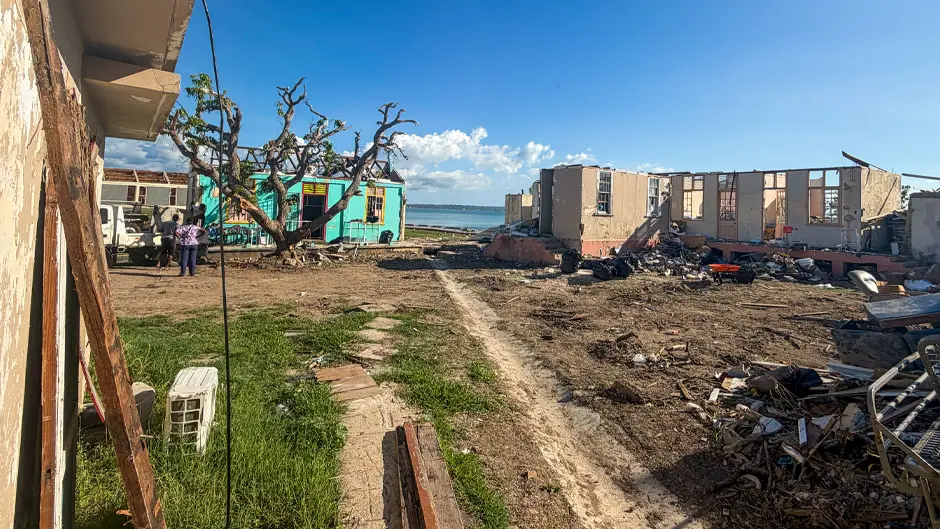
As the plane descended over Jamaica recently, Dr. Pytregay Thompson did not fully recognize the place where she spent the first 27 years of her life.
She remembered an island full of lush tropical trees and foliage dotted with fruit nearly everywhere, but all Thompson could see from the window were blue tarps and little green sticks where trees once stood. The path of wreckage from Hurricane Melissa was unmistakable.
“I wasn’t prepared,” said Thompson, a pediatric resident at the University of Miami Miller School of Medicine/Jackson Health System, who grew up in northwest Jamaica. “Going back home and seeing people with their beautiful homes and lives wrecked was very difficult.”
Yet Thompson swallowed her sadness and remembered why she was making the trip home. She was there as part of an effort led by the Miller School’s Global Institute for Community Health and Development, which is sending a few doctors to the island in rotations to help relieve Jamaican health care providers treating patients in the wake of Hurricane Melissa.
During the next two weeks, Thompson saw 50 to 60 young patients almost every day at three clinics in northwestern Jamaica. She also spent time at the Hanover (Parish) Health Department collecting data on the most common illnesses suffered by Jamaicans. Due to a lack of clean running water, those conditions ranged from skin infections to gastrointestinal issues. While the experience was intense, Thompson feels fortunate she could go.
“Being able to help patients in Hanover reminded me why I pursued medicine,” said Thompson, who was able to treat patients in many of the places she worked before starting her residency in Miami. “I’ve never seen my country and people in this way before, so it was hard, but the trip was rewarding because I knew I was helping.”
Noted as one of the strongest hurricanes on record, Melissa hit western Jamaica in late October, killing at least 45 people and devastating communities across the island. After the storm, Global Institute co-director Dr. Elizabeth Greig said the Jamaican Minister of Health, as well as the Pan American Health Organization, reached out.
Jamaican leaders asked Greig for clinical relief from any Jamaican-credentialed doctors working at UHealth—University of Miami Health System, and a way to consult with trauma experts from the Miller School, as well as guidance from the Global Institute on long-term recovery planning.
“Sending these doctors back to Jamaica was a great opportunity for us because it helps to alleviate the burden of care on the doctors there, and it allows these medical residents to see their families after this devastation,” said Greig, also an assistant professor of general internal medicine. “The Global Institute was also able to turn it into an international rotation, so they are doing clinical work toward their residency.”
So far, Greig and Drs. Kendra Van Kirk and Anjali Saxena from the Global Institute have visited western Jamaica briefly to assess the needs at clinics, hospitals, schools, and shelters.
In addition to Thompson, two other Jamaican-born physicians at UHealth also returned home to support recovery efforts in western Jamaica.
Dr. Shanice Spence-Miller, a current resident in internal medicine, and Kathryn Swaby, an assistant professor of clinical medicine in the Department of Pediatrics, completed two-week rotations in clinics and hospitals in Westmoreland Parish, one of the worst impacted regions from the storm.
During her two-week rotation, Spence-Miller was stunned by the extent of the devastation to southwest Jamaica, where she grew up. Entire communities in St. Elizabeth Parish and its neighboring Westmoreland Parish were gone. Concrete homes were flattened, and there were few signs of life in places that were bustling towns just months before.
At Savanna-La-Mar Public General Hospital and the nearby clinic where she worked, Spence-Miller saw nearly 40 patients per day. She treated Jamaicans with complications of chronic medical conditions, acute infections, and illnesses exacerbated by post-hurricane conditions, including suspected leptospirosis, dengue fever, and gastroenteritis. She also completed overnight hospital duty, which underscored the level of need among Jamaican patients. Still, Spence-Miller was glad she was able to help her country, even for a short time.
“Despite the challenges people are facing, there was a strong sense of resilience and gratitude in Jamaica,” she said. “That spirit is what I want people to remember about Jamaica. Its recovery will not only require short-term support but sustained long-term investment in health care, education, and community infrastructure.”
Toward that goal, in Miami, Greig and Van Kirk are now working with Drs. Carl Schulman and Antonio Marttos at the William Lehman Injury Research Center to set up a telemedicine line so University doctors at the Ryder Trauma Center can advise Jamaican physicians on challenging cases. And Van Kirk, Saxena, and Spence-Miller are working with Jamaican officials to set up spaces in shelters for children to begin reading and learning again and are encouraging them to open some schools.
“Getting safe learning spaces reestablished for children as soon as possible is a critical part of recovery,” added Van Kirk, an assistant professor in the Division of Internal Medicine and Pediatrics.
The Global Institute has a history of lending medical guidance to its neighbors. In 2010 it coordinated and helped staff a 250-bed field hospital when a major earthquake impacted Haiti. And in 2019, Global Institute physicians visited the northern Bahamas to help after Hurricane Dorian devastated the islands. They are still working with the Bahamian government on long-term resilience programs such as mental health support, setting up a medical training center, and sustainable housing plans.
“We hope that this work in Jamaica could work out like the project we have in the Bahamas, where they use this short-term support in a way that makes sense for them, and then we can provide medium- to long-range support and guidance as an academic partner,” Greig added. “As the acute care ends, the recovery still goes on for months and years, and there’s this gap where there’s still so much to do.”
In the coming weeks, Van Kirk hopes to return to help establish health education programs and child-friendly spaces and to help Jamaican health providers continue to offer the best care possible. Spence-Miller also wants to continue supporting Jamaica’s health and education systems through future visits, telemedicine, and long-term partnerships.
And while Hurricane Melissa clearly took a heavy toll on their country, Thompson and Spence-Miller agreed that Jamaica will recover.
“We will get back to our lush, green, beautiful country with our spirits uplifted again,” Thompson said. “It will take time, but we are who we are, and we will get back to the people we were meant to be.”
