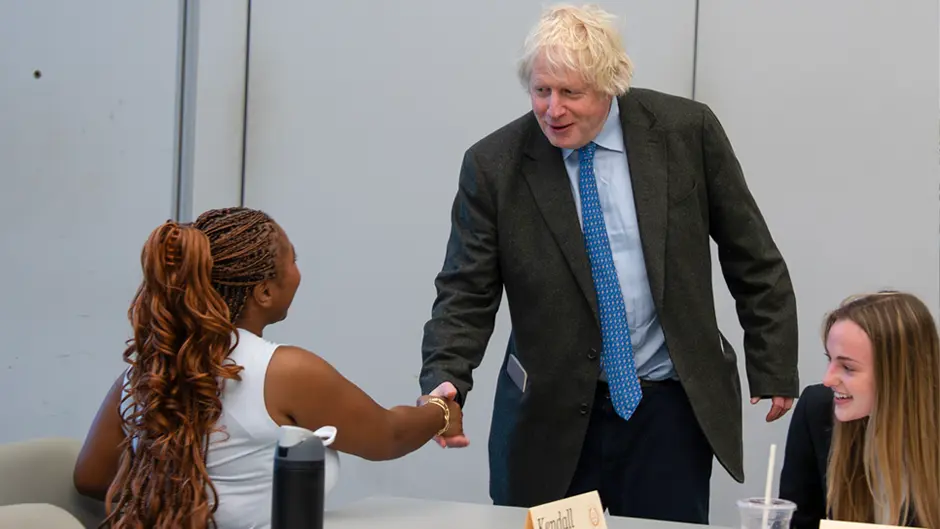
Before she arrived at the University of Miami last fall as a first-year student, Lauren Montgomery had only read articles about former British Prime Minister Boris Johnson in newspapers and magazines, never getting the full impact of his distinct personality.
“Those stories, while good, just didn’t capture his voice, his mannerisms, his sense of humor,” said the classics and international studies major.
That all changed on Tuesday when Montgomery and about 170 other students got an up-close and personal view of Johnson, attending a class lecture at the University’s Whitten Learning Center where the former Conservative Party leader, known for tousled hair and maverick leadership style, detailed the chain of events and his efforts that led to the U.K.’s withdrawal from the European Union (EU).
“I was completely entertained and pleasantly surprised by how engaging he was,” Montgomery said during a 10-minute break in Johnson’s talk. “I’m ready for two more hours.”
Johnson’s visit, the first of four planned for the spring semester, was part of the class Special Topics in Public Administration, Policy, and Law, a three-credit course he is teaching in collaboration with Casey Klofstad and Joseph Uscinski, professors of political science in the College of Arts and Sciences.
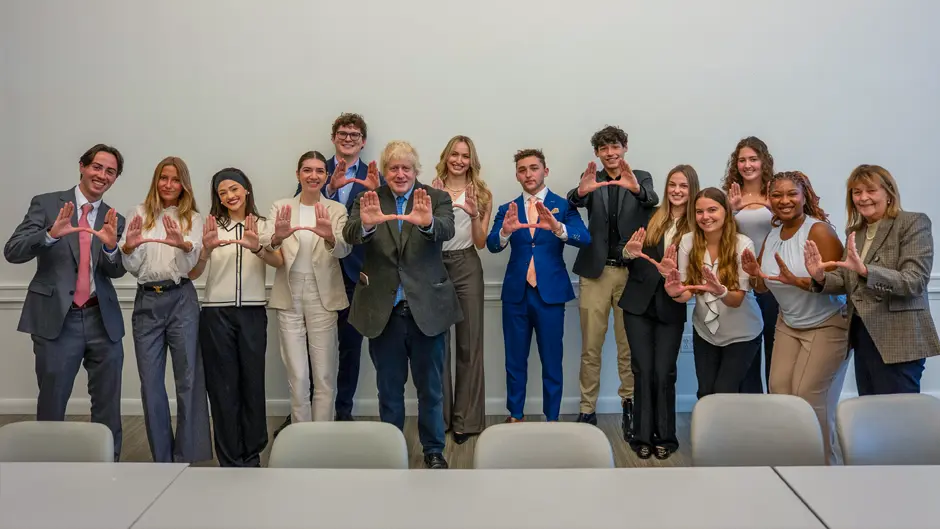 On Wednesday, Johnson met with student leaders at a luncheon held in the Donna E. Shalala Student Center.
“The buzz has been amazing,” Uscinski said of Tuesday’s lecture, themed “Britain’s Boris Johnson: Leadership, Legacy, and Lessons Learned.” “There are so many students excited to hear his perspective and to learn about British politics.”
Before he became prime minister, Johnson served as mayor of London, and in the final months serving in that role, he became a key figure and well-known public face of the “Vote Leave” campaign in the lead-up to a 2016 national referendum on EU membership. That referendum resulted in a 52 percent to 48 percent margin in favor of leaving the EU, a powerful political and economic bloc of some 27 European nations governing common economic, social, and security policies. Johnson was subsequently appointed to the Cabinet as foreign secretary following the referendum result.
Johnson was considered a major influence in the “leave” side’s slim margin of victory in the referendum, with polls showing voters trusted his opinion on Brexit—the term coined for the U.K.’s EU exit—more than other politicians. Johnson, he said during his talk inside a packed Whitten Learning Center’s classroom, regarded himself as one of “a ragtag and bobtail army of people who thought we could do better outside the EU.”
“It was the biggest vote for any proposition, any government in the history of our politics, and it led to a complete crisis in the U.K. because it was a conflict between direct and representative democracy,” Johnson said of the referendum, noting that, despite 17.4 million people voting in favor of Brexit, representatives in the U.K. Parliament refused to give in to their wishes, creating a stalemate.
“The people had clearly voted to come out of the European Union,” he continued. “And when you consider the size of the pressure that they were under, the arguments that were being made by all respectable opinions, it was astonishing that so many people actually had the courage to vote to leave.”
After Theresa May resigned as prime minister in May 2019, Johnson was elected leader of the Conservative Party and became the U.K.’s 77th prime minister in July, eventually executing Brexit in that capacity. He served as prime minister until September 2022.
“He took us on this amazing journey of how he got Brexit done, and he made us feel comfortable with his sense of humor,” said first-year student and political science major Julia Marsala. “He was riveting, and I can’t wait for his other three talks.”
Having the former U.K. prime minister participate in the course “gives students the chance to connect classroom learning with real-world political leadership. Experiences like this spark the kind of thoughtful engagement that defines the University of Miami’s strong academic community,” Uscinski said.
“A unique opportunity for our students to hear from a public figure who has been on the world stage” is how Joel Samuels, executive vice president for academic affairs and provost described Johnson’s visit. “Students were able to learn about his experience being at the helm of city government and parliamentary policymaking and the challenges he faced in championing and debating geopolitical and economic issues.”
During Wednesday’s Conversation with Change Leaders lunch in the North Activities Room of the Shalala Student Center, 12 leaders from the executive board of the University’s undergraduate Student Government took turns explaining to Johnson their roles on the governing body, from campus initiatives they have helped spearhead to their commitment in ensuring those projects meet the needs of students.
“Our goal is to promote conservation on campus, so we’re one of the most important outlets for students who are interested in sustainability,” Margaret Todd, ECO agency chair, said to the former British prime minister, explaining to him that her team led efforts to secure solar panels at the food court and recently spearheaded the acquisition of a solar bench where student can plug in their laptops while working outside.
Kate Crandall, director of academic affairs, detailed for Johnson how her group has organized pilot events on how to use artificial intelligence as supplementary tools in the classroom to facilitate learning.
“It’s going to change everything, and huge chunks of the academic world will be affected by it,” Johnson told Crandall, adding that more conversation is needed on how to use AI.
With Pat Whitely, senior vice president for student affairs and alumni engagement, looking on, Johnson regaled the students with anecdotes from his own time as a college student and praised the University and South Florida community for the roles they can play in the changing U.S. economy. “With the way the talent is flowing south, UM will become more important because of that,” Johnson said.
“It was interesting to hear his viewpoints on how higher education plays such an important role in fostering community and affecting politics, not only at the local level but also from an international perspective,” said Ivana Liberatore, president of Student Government. “What an honor it was to have someone like him engage with us on such a personal level.”
