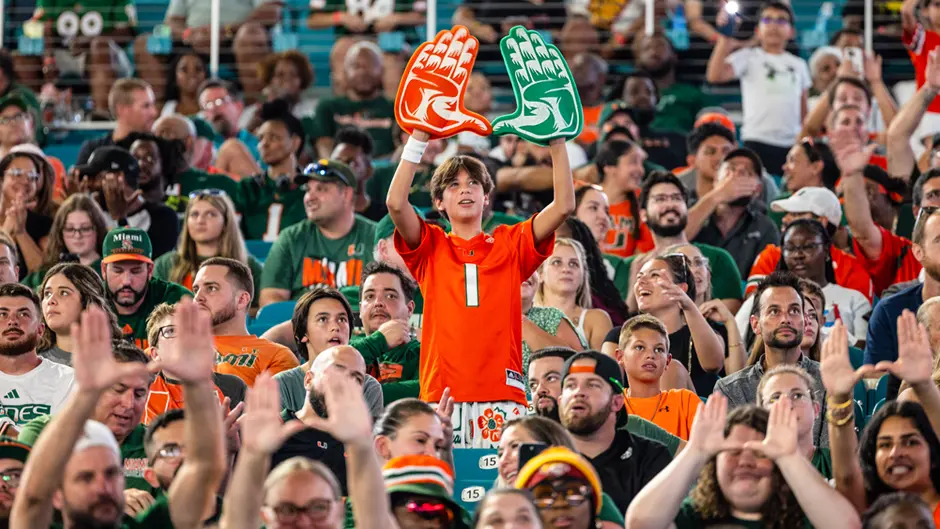
The Miami Hurricanes are coming home to clinch what could be a sixth national title in program history. And when University of Miami fans pack Hard Rock Stadium on Jan. 19 to watch the national championship, they’ll be immersed in game-day traditions that have pumped the stands with pride and swagger for generations.
Sebastian the Ibis
The most notable presence at any Hurricanes football game is Sebastian, the affable ibis that has been the University’s official mascot since 1957. A symbol of courage, the ibis is a wetland bird known as one of the last wildlife to leave its habitat before a hurricane and the first to return after the storm. Every touchdown at Hard Rock Stadium is an opportunity for Sebastian to do a C-A-N-E-S spell-out.
 Four fingers up
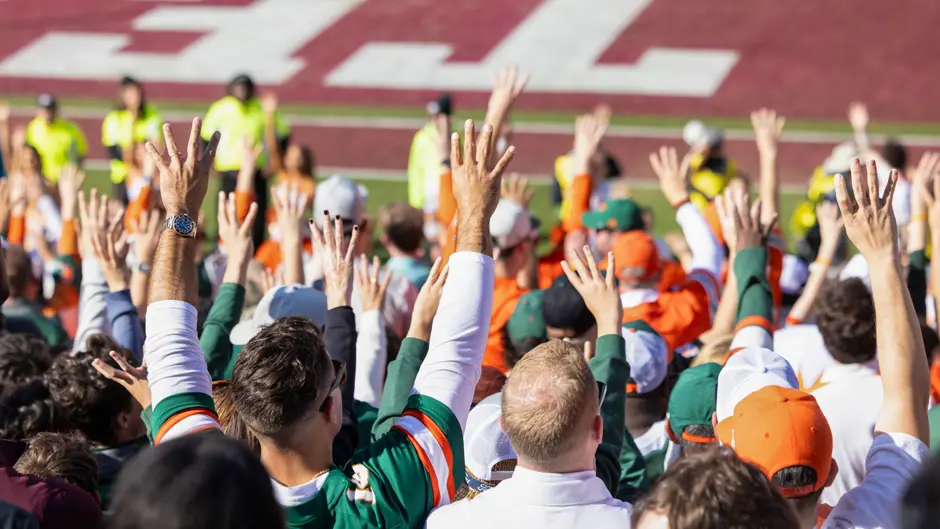
At the start of the fourth quarter, Canes fans will hold up four fingers. This represents the belief that the game is won in that crucial final period—and no matter the score in that moment, the Canes will fight for a victory. This gesture, however, is not as ubiquitous as the one that unites Canes far and wide today—the U.
A properly formed U
The orange and green split-U mark was introduced in 1973, commissioned by the student-athlete scholarship fund now known as the Hurricane Club. The practice of throwing up the U originated in 1992 when former cheerleader Bill Tigano flashed the hand gesture during a football home game against Florida State University. The University adopted the split-U athletics mark as its official institutional mark in 2009. New students and their parents now get a primer on how to properly signal their spirit from cheerleaders and members of the Sunsations at every new student orientation event.
 Soundtrack to success
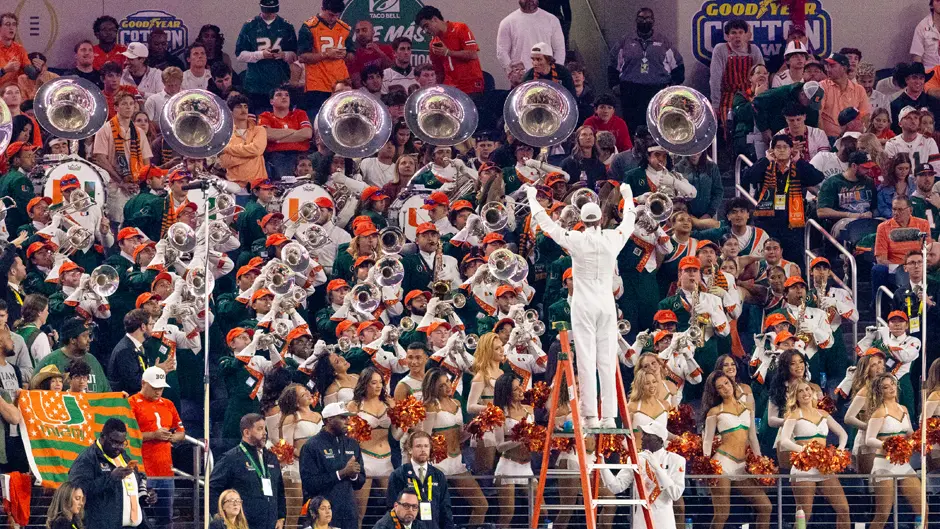
When the trumpets sing, the tubas bellow, and the drums reverberate throughout the stadium, look to the Frost Band of the Hour—the spirited marching band that has delivered every game day soundtrack since 1926. Seventeen students came together that year to form the University Band, renamed Band of the Hour in 1949 when an Orange Bowl announcer introduced Henry Fillmore’s march with an impromptu quip: “‘The Man of the Hour’ will now be performed by the Band of the Hour.” A gift from philanthropists Phillip and Patricia Frost in 2000 to secure the band’s financial stability resulted in the current name.
Alma mater
At the end of the game, the Frost Band of the Hour will play the University of Miami Alma Mater, written by University employee William “Bill” S. Lampe and composed by music student Christine Asdurian in 1926. While singing, Canes hold up one finger that sways from side to side like a palm frond in the wind.
 Tunnel of smoke
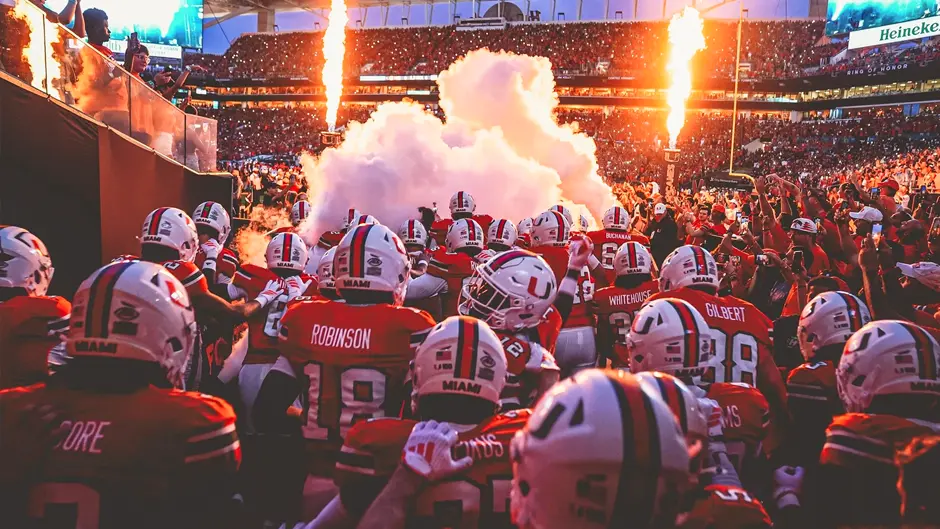
While one of the signature moments of any home game is the tunnel of smoke the players and coaches run through as they enter the field, Monday’s game is technically not a home game for the Canes. Plan on seeing a slightly different approach to the on-field arrival as that is being choreographed by the College Football Playoff. But if you were wondering, the tunnel of smoke dates back to the 1950s, when the University’s transportation director at the time, Bob Nalette, used fire extinguishers to create the now-famous fanfare when the team barreled onto the Orange Bowl turf. Now each fall, first-year students are invited to run through the tunnel as well during the first home game of the season.
Rise of a football powerhouse
Hurricanes football fans have waited 25 years to sway that palm frond at a championship game, but the growth of the program into a national powerhouse is a century-long journey marked by fits and starts, a historic rise and fall, and a slow, steady burn back to the top.
The first Hurricanes football game was on Oct. 23, 1926, followed by the first bowl game in 1933. In 1945 the Hurricanes won their first Orange Bowl, under head coach and athletic director Jack Harding. Andy Gustafson took over the reins in 1948 and led Miami to a record-high No. 6 ranking in 1956.
Then the program’s momentum hit a snag in the 1970s. Five different coaches served through a 10-year stretch, and there were talks of disbanding the program until Howard Schnellenberger, named head coach in 1979, led the Hurricanes to their first national championship in 1983. This kicked off an era of dominance, with championships following in 1987, 1989, and 1991 under head coaches Jimmy Johnson and Dennis Erickson, respectively.
Another national title would follow in 2001, and during that near two-decade span, the Hurricanes produced two Heisman Trophy winners in Vinny Testaverde and Gino Torretta, as well as dozens of All-Americans, including the likes of Warren Sapp, Ray Lewis, Santana Moss, Ed Reed, Willis McGahee, and many others. Eleven Hurricanes, including Michael Irvin, have gone on to be enshrined in the Pro Football Hall of Fame.
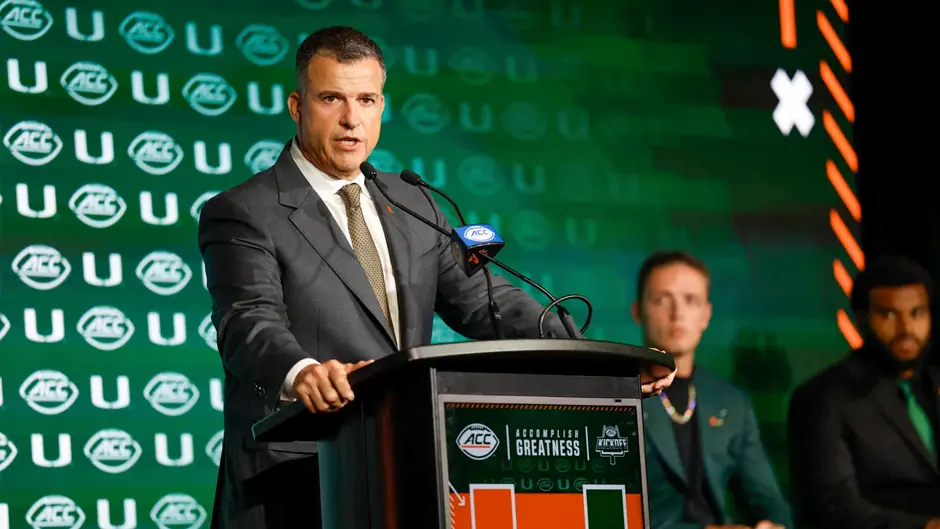 Since 2021 the Hurricanes have been led by one of their own, former two-time national champion offensive lineman Mario Cristobal. Also in 2021, fellow alumnus Dan Radakovich joined the U as director of athletics, both men serving in the administration of a diehard Canes fan and fellow alumnus, President Joe Echevarria.
For Cristobal, Radakovich, and Echevarria—as well as generations of Canes who never stopped throwing up the U or singing the alma mater regardless of the team’s record or ranking—this season’s homecoming is a memory that will be cherished forever.