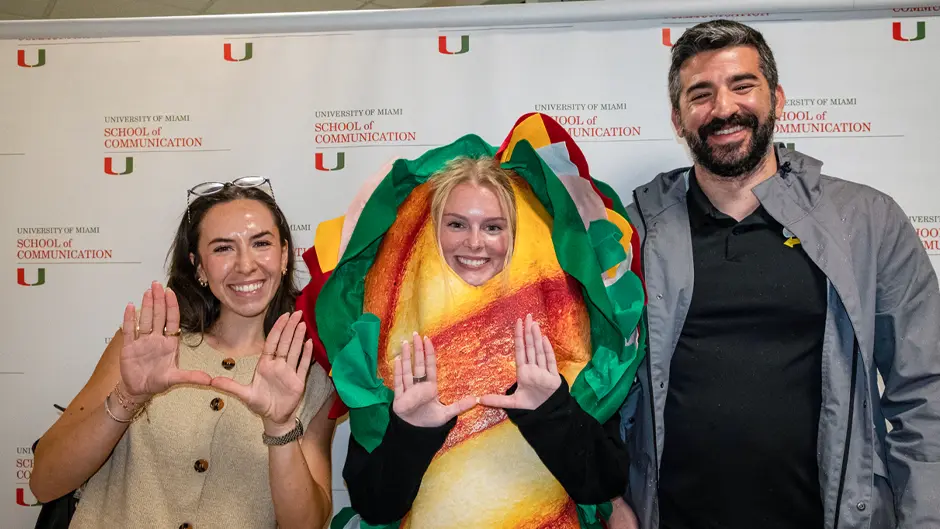
When Sabrina Pizziol, manager of brand public relations for Subway, returned to a University of Miami classroom this semester, she did so from the opposite side of the table.
Pizziol, who graduated in 2020 with a degree in public relations from the School of Communication, partnered with students in the public relations senior capstone course. It was the same class she completed as an undergraduate just years earlier.
“When I took this class as a student, being the client felt like such a far-off dream,” Pizziol said. “I never imagined it would be me just five years after graduating. Coming back with Subway made me feel incredibly proud of my alma mater.”
The PR capstone, often referred to as the Campaigns class, challenges seniors to develop a comprehensive communications campaign for a real client. Rather than functioning like a traditional lecture-based course, the students work in teams to conduct research, identify target audiences, and create strategic and creative materials. The semester concludes with a formal presentation to the client.
“This is unlike any other course in our program,” said Heidi Carr, assistant professor of professional practice and director of the undergraduate PR program. “It’s really a class about soft skills. There are categories in the rubric for communication, leadership, collaboration, and making deadlines. It’s the ultimate team project.”
In past years, students in the course have developed campaigns for a range of clients, including Chewy, March for Our Lives, and Wynwood Walls. For this cohort, the client was Subway, a global brand seeking new ways to engage Gen Z audiences.
“Subway asked us to get Gen Z meaningfully involved with the brand,” said Madison Jursca, a senior double majoring in public relations and marketing. “We realized quickly this couldn’t be approached from an established marketing mindset. We had to think for ourselves and focus on what would actually feel authentic.”
Jursca said the scale of the brand became clear early in the process.
“I didn’t fully grasp the scale of Subway until we started working with them,” Jursca said. “There truly is a Subway almost everywhere you go.”
Students functioned like a professional agency, breaking into specialized teams focused on research, community partnerships, creative development, and strategy. Their work included nationwide surveys, messaging, community outreach, corporate social responsibility initiatives, creative mockups, and proposed budgets.
“Our class truly functioned like a real agency,” Jursca said. “We developed ideas, filtered them, refined them, and pitched directly to the Subway team. It felt just as real as my internship experiences.”
For Pizziol, watching the students navigate that process brought back memories of her own time in the course.
“The level of thought, creativity, and professionalism the students brought to their work was truly impressive,” she said. “It was a powerful reminder of how much this program prepares students for the real world.”
Pizziol began her journey as a Cane in 2016 as a public relations major and remained deeply involved in the School of Communication, including serving as president of the Public Relations Student Society of America. She said the capstone course helped her develop the skills necessary to thrive in the public relations industry.
“This course taught me how to think strategically, not just creatively, but how to support ideas with data, objectives, and clear rationale,” Pizziol said. “It mirrors the pressure of real client work.”
The partnership between Subway and the University grew out of Pizziol’s ongoing relationship with the School of Communication and Carr. After returning to campus as a guest speaker, Pizziol explored the idea of bringing Subway into the classroom as a capstone client, an opportunity Carr said was uniquely fitting for the course and its students.
“Having Sabrina as the liaison was perfect,” Carr said. “Having gone through this herself, she understood what we would do. And honestly, I think we blew her away.”
Kylia Brown, a senior in the School of Communication, said that the experience forced students to expand their perspectives.
“Working with a global brand like Subway pushed me to think beyond what works in the U.S. and consider what needs to work across different markets,” Brown said.
Brown led her team’s research efforts, which required students to gather original data beyond the University community to inform their recommendations.
“One of the biggest challenges was leading the research effort,” she said. “Managing deadlines and assigning responsibilities taught me how to lead under pressure.”
For students preparing to enter the field, the experience made the future feel tangible.
“Hearing feedback from someone who was once in our shoes made the work feel real,” Brown said. “It showed me that the skills we’re practicing can actually influence real business decisions.”
