For most Americans of an age to remember, the attacks of Sept. 11, 2001, are indelibly seared in our minds and memory.
Yet many students and others who are part of the University of Miami community today were not yet born and may not realize the magnitude of the events that day. The attacks altered the history of our country and indeed the world, not only because of the tragedy—the deaths of 2,983 civilians and the untold associated trauma—but equally so through the inspiring acts of bravery, compassion, unity and service in response.
The country staggered at first. But with an outpouring of unity, goodwill and courageous service, community by community and, as a nation, the United States united and regained its footing. Remembering that response a quarter century ago reminds many that the national legacy of resilience persists.
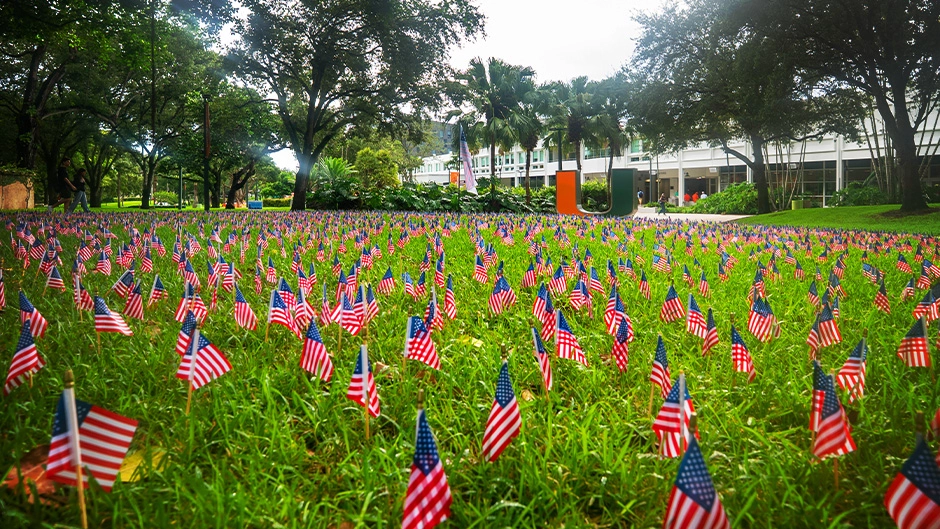
The University is marking the anniversary with a series of events that include a “Field of Honor” placing of mini flags behind the U statue; a “9/11 Ruck to Remember” on Sept. 12; a film screening of “9/11: Reclaiming Ground Zero (2026)” on Sept. 15; a “9/11 Flag of Honor” and display of books associated with the tragedy in the Otto G. Richter Library; and a tolling of the carillon bells on the morning of 9/11. Contact the Veterans Resource Center for details.

The faculty and staff members below shared where they were on the morning of the attack and how that day changed their lives.
Michael Berkowitz, executive director of the University’s Climate Resilience Institute, grew up in New York City and worked in city government for eight years.
On the morning of the attacks, I was at the New York City Office of Emergency Management, where I was serving as planning director (promoted to deputy commissioner in 2001). Our office was in 7 World Trade Center across the street from the north tower. I was in the building at the time when the first plane crashed, and we were right under the north face of tower 2.

Our office served as the hub of operations to coordinate the response, and all the agencies—departments of buildings, police and fire—were there. We were still there when a second plane hit the south tower. Then the Federal Aviation Administration informed us that a third plane had been lost, and we evacuated. Right when we got to the bottom of the street, the first tower went down with a loud boom. My colleagues and I ran north, tons of debris raining down from above. It felt like it was chasing you, although we now know it was the south tower which had collapsed. When I saw a loading dock attached to Manhattan Community College, I got in under it, continued to move north, trying to account for the people working with me. Eventually we gathered at the police academy building in Murray Hill, Manhattan, which we repurposed as a makeshift emergency operations center.
9/11 underscored how connected we are to what’s going on in the rest of the world. Previously, we thought in the U.S. that we were immune to these horrific effects and when it lands on your doorstep, it makes you realize that what’s going on in the rest of the world does matter here.
That day changed the trajectory of my career. I had been responsible for public-private partnerships for the city’s Office of Emergency Management, and this was a massive disaster in a densely populated public-private business district, so we had to figure out how to get the New York Stock Exchange back up and running and people on Wall Street back into offices and financial markets going.
Five years later, I went to work for Deutsche Bank, one of the most impacted companies from 9/11. My work with them set me on the course of thinking about resilience in new ways. I moved to India, Singapore and London as their head of operational risk. That role led to the 100 Resilient Cities Initiative at the Rockefeller Foundation to help municipalities build resilience to the physical, social and economic challenges before coming to the University of Miami. None of that would have happened without me playing a central role in the 9/11 response.
“Jack” Wesley P. Miller IV, associate professor of practice, Department of Strategic Communication, School of Communication
I was a major on active duty and an Air Force ROTC instructor at the University, working in what was then Rhodes House. I had the television on in my office and saw the first plane hit the World Trade Center. My first thought was that it had to be an accident, the kind of tragedy New York had seen before, like the wartime crash into the Empire State Building. Then the second aircraft went in. I still remember the chill of that instant, because I knew it was no accident and that American life, including my own, had just changed. As the day unfolded, we learned about the Pentagon, where I had many friends, and the crash in Pennsylvania, whose passengers we later recognized as heroes. I thought the death toll might reach 10,000. It was lower than that, but the meaning of the day was already clear.
That morning set the course of the rest of my military career and much of how I see service and the country. I expected we would spend years at war, and we did. I deployed again, including substantial time in Afghanistan, the Horn of Africa, Iraq, and elsewhere in the Middle East, and later worked Middle East policy from the Pentagon. I represented the Pentagon in New York when Ground Zero was still an open site, worked with organizations such as Tunnel to Towers as they were getting started, spent time at the Pentagon memorial, and escorted media to Guantanamo Bay for proceedings involving Khalid Sheikh Mohammed (considered an architect of the 9/11 attacks). Everyday life changed too: Homeland Security, TSA and a country that no longer let families walk to the gate to watch a plane take off. America can feel divided now, but one thing that came out of 9/11 was a unity I had not experienced since the stories of World War II. People were proud of this country and stood tall for the red, white and blue. 9/11 was not only a morning of loss, it was also a reminder of what we owe one another when the unthinkable happens and how strong this country can be when it chooses to stand as one.
Laura Kohn-Wood, professor and dean, School of Education and Human Development
I was a second-year assistant professor in the Department of Psychology at the University of Michigan, standing in the fourth-floor conference/classroom of East Hall and teaching my undergraduate service-learning class. Not everyone had a cell phone back then, but one student who did stood up in the middle of the class and yelled that a plane had hit the World Trade Center. She was from NYC and had gotten a call from her mother. Without a television or any other information, the scope of what happened was unclear. I announced that anyone who needed to leave class should do so and then said we would take a moment of silence to honor anyone hurt or killed by this “accident.” It wasn’t until much later that I learned, along with everyone else in the country, the full scope of the horror, and that it wasn’t an “accident.”
What I remember thinking about quite a bit, once we all knew what had happened and why, was having an almost visceral and shocking realization that “we” as a country were truly hated and targeted by such a horrific, planned and coordinated attack. Of course, it is one thing to know this intellectually, but quite another to know it emotionally and to see the effect of this hatred in real life. As a community and clinical psychologist, it got me thinking about the root causes of hatred and the kinds of collective action that could prevent something like this in the future. I also remember thinking: Is this the Kennedy assassination moment for my generation (X)? Obviously, very different tragedies, but the scope and meaning for which, one never forgets where they were when it happened.
Patricia Sanchez Abril, dean, Miami School of Law and M. Minnette Massey Chair in Law
I was in a London taxicab after lunch when we started seeing people flock to the television sets in pubs to see what was happening in New York. At the time, I was an early career lawyer and had many friends who worked in or near the towers. I will never forget that the taxi driver turned to me and said, “My condolences for your country.” Those words still haunt me.
Prior to 9/11, we thought we were immune to such an attack. In fact, we may have taken our security for granted. Such acts of violence were events that happened in other countries—the countries many of our parents and families fled. The collective experience was one of profound sadness, unimaginable loss and the realization that we, too, were fragile and susceptible. The events that day were an important reminder never to take for granted freedom, democracy and security.
Joseph B. Treaster, professor, Department of Journalism and Media Management, School of Communication
I had just finished an interview in a mid-town hotel and went into the bar for a cup of coffee. I looked up at the TV and saw what looked like a small plane stuck in one of the World Trade Center towers. I phoned my news desk at The New York Times. The editor was seemingly unaware of what was going on at the towers.
I grabbed a cab and sped toward the towers. At about 23rd Street the driver said, “This is as far as I’m going.” I jumped out. I couldn’t get taxis or police or fire trucks to pick me up. I ran a mile or two to the towers. I was very close to the base of one of the towers. I tripped over a landing gear. I could see the plane was huge and not a light plane.
On a street corner, I saw a payphone and moved to use it. A policemen tried shooing me away. “Press. I’m a Times reporter,” I shouted at him, picking up the phone. “There’s a bomb there,” he yelled back.
I dropped the phone, backed up a little and started to run. Just behind me the first of the towers was beginning to crumble. I ran faster. At the first intersection, I turned and watched the cloud of debris roar down the street.
Over the next few weeks, I wrote a few stories about businesses brushing off the World Trade Center dust. I think my life kind of tightened up, though I didn’t realize it then. I’d already reported on half a dozen wars in Asia, the Middle East and Central America, but the attack on the World Trade Center was the worst single event of my life. I just shifted my notebook and kept on reporting.
Writer Janette Neuwahl Tannen contributed to this article.