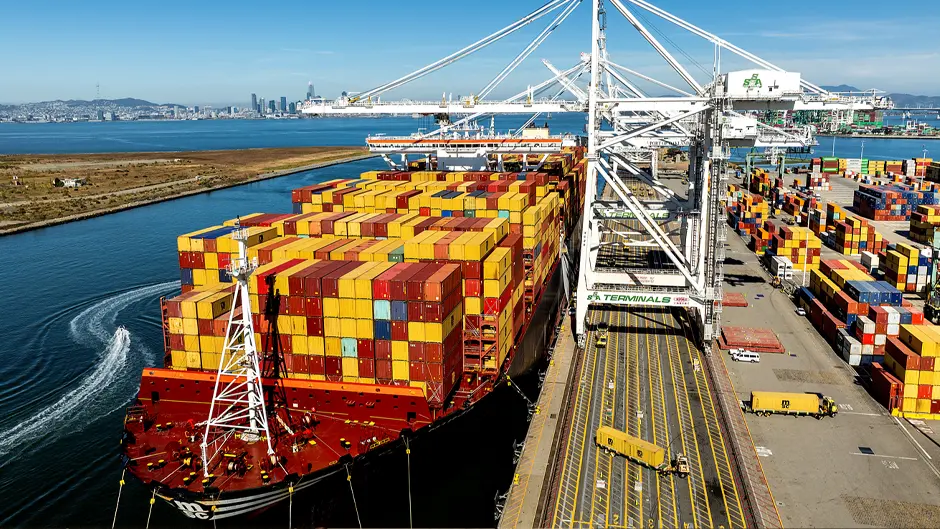
With outcomes both beneficial and detrimental, for the past five decades the international business world has pursued a unified global strategy, emphasizing open trade and specialization of country resources and endowment, underpinned by global trade rules and institutions such as the World Trade Organization.
Yet with stunning rapidity, that landscape has collapsed, giving way to the current landscape described as “fragmented globalization,” “slowballization,” or “globalization in transition” by Yadong Luo, management professor and the Emery M. Findley Jr. Distinguished Chair with the University of Miami Patti and Allan Herbert Business School.
New research by Luo and his longtime collaborator Rosalie Tung, past president of both the Academy of Management and the Academy of International Business, introduces a novel mindset designed to help multinational enterprises (MNEs) navigate and thrive in today’s geopolitically and geo-economically fractured global landscape.
“The concept of a multipolar geostrategy highlights a firm’s ability to orchestrate value-creating activities across geopolitically polarized zones. Within a given pole, key activities tend to be tightly coupled—interdependent and integrated. By contrast, activities that span across different poles are more loosely coupled, and in some sensitive domains may even be deliberately decoupled,” Luo explained.
“Yet it’s as much a managerial philosophy or logic as it is a strategy,” he emphasized. “Because a multipolar strategy will never be one-size-fits all. Unlike other strategies that firms can imitate, a multipolar strategy can never be standardized across the board—it’s more a mindset adopted by a firm’s board of directors and C-suite level people.”
However, aligning with geopolitical dynamics entails trade-offs. Firms may incur higher costs and diminished global economies of scale, along with losses from duplicative operations created to accommodate geopolitical dissonance. This, in turn, raises a question of how to organize a multipolar model.
Structurally, MNEs are likely to integrate both polar- and region-centric forms. A polar-based design organizes operations around major geopolitical zones, which function as central hubs for managing activities within their respective blocs, Luo explained. This arrangement enables each pole to exercise substantial decision-making authority consistent with its political and regulatory context.
A multipolar geostrategy centers on the concept of “multi,” emphasizing the importance for MNEs to embrace multilateralism yet in realistic ways. This approach stands in contrast to unipolar (U.S.-centered) or bipolar (U.S.-China-centric) strategies, which may limit flexibility and increase vulnerability to geopolitical disruptions.
One viable pathway toward a multipolar strategy is to invest in geopolitically neutral and geo-economically strategic gateway nations—often referred to as “geopolitical balancers.” Countries such as Singapore, Saudi Arabia, Mexico, and Vietnam frequently serve as intermediaries, leveraging their neutrality to bridge conflicting blocs.
Secondly, firms should assess their varying exposure to geopolitical risks. While many are diversifying supply chains through near shoring and friend shoring, China and India remain central to global trade across numerous sectors. Restrictions are most likely to arise around high stakes products and technologies tied to national security and economic sovereignty, Luo noted.
Third, Luo observes that many large high-tech firms are strengthening their global risk management divisions. Companies such as Google and Meta have appointed senior executives with titles such as “chief global affairs officer” or “chief global risk officer.” These positions are often filled by former government officials with expertise in international politics, regulatory affairs, and lobbying.
What does it take to be more geopolitically viable?
First and foremost, Luo said, is geopolitical intelligence.
“If I’m running a mid-sized company in Florida, I may not need to restructure, but I absolutely must be geopolitically intelligent and aware of what is happening in, say, Mexico and China, and how their latest relations with the United States are unfolding,” he said.
Luo cited the recent example that the Mexican president announced new tariffs on Chinese vehicles.
“I am sure China is analyzing this move and would be concerned about how they might respond and how China–Mexico economic relations could be disrupted. Firms need to remain extremely vigilant to this type of information,” Luo said.
Second, Luo emphasized the viability and resilience of global supply chains, even amid geopolitical disruptions. “On the one hand, geopolitical frictions can be highly disruptive,” he noted. “On the other hand, global supply chains have proven remarkably adaptable, reinforced by the rise of the Global South, which accounts for 83 percent of the world’s population—about 6.4 billion people. As these emerging economies advance, firms gain more alternatives for structuring global supply chains.”
Third, Luo stressed the critical need for corporate executives to give full attention to the voices, concerns, and feedback of foreign subsidiaries, particularly those operating on the front lines in geopolitically sensitive regions.
While reporting channels to headquarters exist, front-line executives are often not incentivized to share their perspectives. “They must be explicitly invited to do so, and headquarters decision-makers need to actively engage their first-hand experience,” Luo emphasized.
Luo concluded that although AI and digital connectivity will continue to shape the future of global business, the intelligence they generate remains largely technical.
“For strategic decision-making, what ultimately matters most is the geopolitical and geo-economic acumen of executives, both at home and abroad,” he said. “Their lived experience and unique insights provide the contextual intelligence that no algorithm can replicate and the acumen essential for firms to navigate an increasingly fractured global environment.”
