Alvin Phan can easily recall when he started transitioning to plant-based foods.
It was four years ago, while he was finishing his master’s degree at the University of Miami Frost School of Music, where he is now a postdoctoral student. He began attending meetings of the Plant-Based Canes and realized he liked the community. But Phan also liked the changes he felt physically and mentally as his diet transformed. His endurance for running improved, and his cholesterol began to decline. Stress became less noticeable.
At the time, he had only run one marathon. Now, Phan has run three.
“I definitely think eating plant-based has helped,” he said.
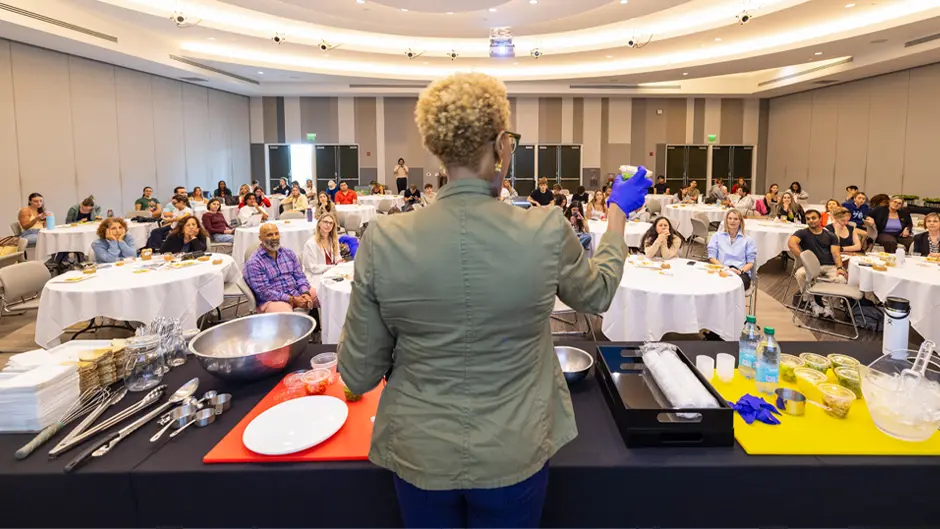
Phan was one of the more than 150 students, along with some faculty members, who gathered in the Donna E. Shalala Student Center ballroom Wednesday to listen to a lunch-and-learn called “Eat Well, Learn Well: The Power of Plant-Forward Nutrition,” hosted by the student organization Plant-Based Canes and sponsored by the nonprofit Physicians Committee for Responsible Medicine (PCRM), based in Washington, D.C.

The program included a keynote by Dr. Brooke Bussard, an internal medicine physician turned lifestyle medicine health coach, who talked about the physiological benefits of eating a diet rich in plants and fiber, while sharing her own life story and struggles with gut health.
In addition to a plant-based lunch, the event also included a cooking demonstration by instructor Shauné Hayes, who struggled with her weight until a health scare nine years ago pushed her to consider dramatically changing her diet. Today, after losing more than 120 pounds and no longer suffering from hypertension, high cholesterol, and other physical pain, Hayes enjoys sharing her journey and runs her own plant-based cooking school in Maryland, while also working with PCRM. At the event, she showed Hurricanes two of her heart-healthy recipes for a green smoothie and a quinoa salad.
Overall, the event outlined the many positive, evidence-based health benefits that come from incorporating more plant-based foods into one’s diet, even late in life, to include more whole grains and a variety of plants.
Bussard focused on the science of the microbiome, which she explained is “an ecosystem of about 37 trillion microorganisms that live in our gut.” Since most of these organisms are found in the gastrointestinal tract (and concentrated in the large intestine), the microbiome’s helpful bacteria digest our food and extract nutrients from it, Bussard explained, while also helping to control our immune system.
Still, it is a careful balance to keep this gut flora content. At times, food particles can get outside the gut lining, causing inflammation and possible allergies to foods, Bussard said.
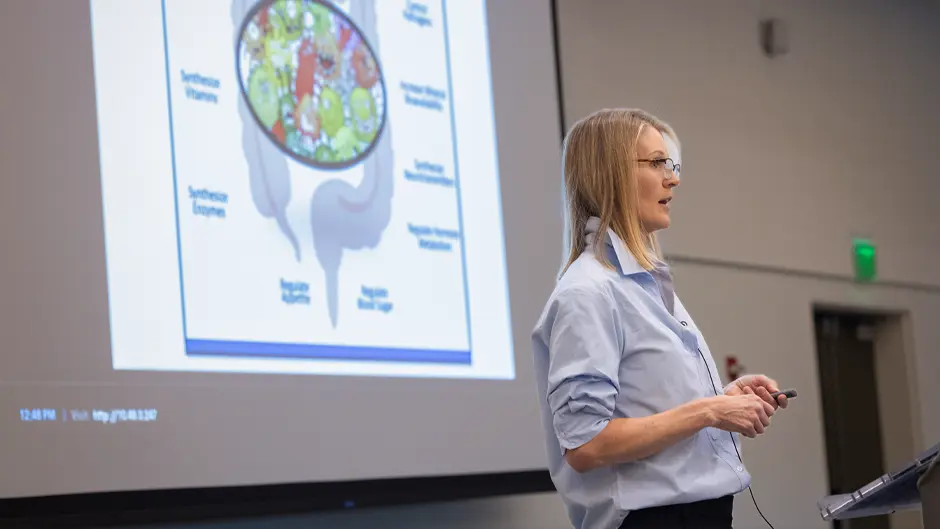
She went on to explain that several studies indicate that eating animal proteins can lead anyone to build up a microbiome that is more susceptible to illnesses such as cancer and heart disease.
“Eating meat, cheese, and other animal products affects the microbiome so significantly that the World Health Organization's International Agency for Research on Cancer even put processed meat and red meat on the list of cancer-causing compounds,” she said.
However, Bussard noted that critical research shows changing one’s diet can improve the microbiome within just a few days.
“So how do we increase our health-promoting microbes? We feed them with fiber.”
Since fiber is found in whole grains, beans, and fruits and vegetables, these are the four main components of a plant-based diet. Bussard shared her own story about struggling with intense stomach pains from the age of 14 and taking several medications that did not help before a family member suggested that certain foods could be causing her pain. Bussard researched the issue and quickly realized the advantages of a plant-based diet. She said it can even eliminate the need for probiotic supplements, adding “the OG probiotics are already in your gut.” She recommended 30 to 40 grams of fiber per day, added gradually to one’s diet.
“The American Gut Project found that if we eat 30 different plant foods per week, it’s really beneficial for our health,” she added. “This is really the best food for our gut bacteria.”
Many students were intrigued by the presentation. Ritesh Alwani, a junior studying business economics, heard about the event through his kinesiology class. Alwani said he has researched a bit about health and nutrition for himself, but Bussard’s presentation helped underscore the information he is learning.
“I realized there are real differences in what you should eat and how and that supplements cannot be used to replace the nutrients and minerals you get from whole foods,” he said. “It was a different take on nutrition, and I am convinced that plant-based could be a better lifestyle, but it may be tough for me to do full time.”
Regardless of the takeaways, Gabriel Izaguirre, president of Plant-Based Canes, and lecturer Michelina Witte, faculty advisor for the organization, were glad that so many students participated. Izaguirre chose to go vegan in recent years because like Bussard, he too struggled with stomach pain. His new diet did help eliminate some of the issues, so he has maintained his mostly plant-based diet. Izaguirre hopes the club can host more events like the lunch-and-learn, which was a first for Plant-Based Canes and PCRM at the University.
“I hope people can realize that eating plant-based is not so restrictive, and we would like people to go out and try more plant-based options,” he said.
Interested students can engage with plant-forward nutrition through weekly community dinners hosted by Plant-Based Canes in partnership with UM Dining. Free and open to all students (and posted to the PBC Engage page and GroupMe), the dinners are held each Wednesday at 7 p.m. on the outdoor patio of the Mahoney-Pearson Dining Hall. Chef Vincent and the UM Dining team prepare rotating plant-based menus designed to introduce students to accessible, nutrient-dense meals in a welcoming setting.
