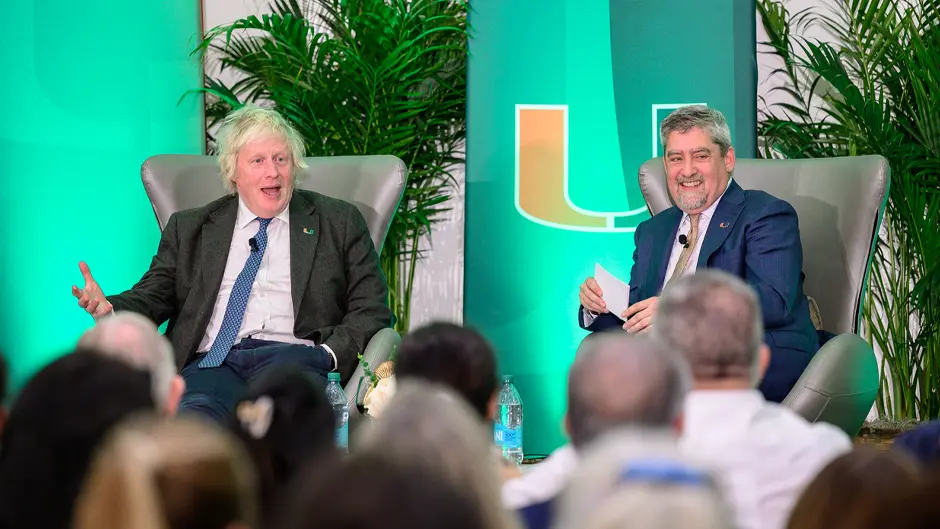
Foreign policy, the importance of higher education, his forthcoming book on William Shakespeare, and one of his biggest regrets while leading the United Kingdom—these were a few of the topics former British Prime Minister Boris Johnson discussed during a wide-ranging conversation with Joel Samuels, the University of Miami’s executive vice president for academic affairs and provost.
The event, held on Feb. 19 in the Donna E. Shalala Student Center, was hosted by the University and the George P. Hanley Democracy Center in the College of Arts and Sciences.
“Preparing thoughtful, informed citizens is central to the mission of a university and to the vitality of a democratic society,” said George Hanley, founder and benefactor of the Hanley Democracy Center, in his opening remarks. “Tonight’s event reflects that commitment. By convening serious conversations grounded in ideas and mutual respect, we seek to strengthen the habits that sustain democratic culture.”
The event was part of Johnson’s role as Provost’s Visiting Lecturer and Distinguished Arts and Sciences Scholar at the University, which includes co-teaching a political science course and speaking to students in a variety of classes about his extensive public service experience as prime minister, leader of the Conservative Party, foreign secretary, and mayor of London. Johnson’s appointment at the University is supported by a gift from Kenneth C. Griffin, founder and chief executive officer of Citadel and founder of Griffin Catalyst.
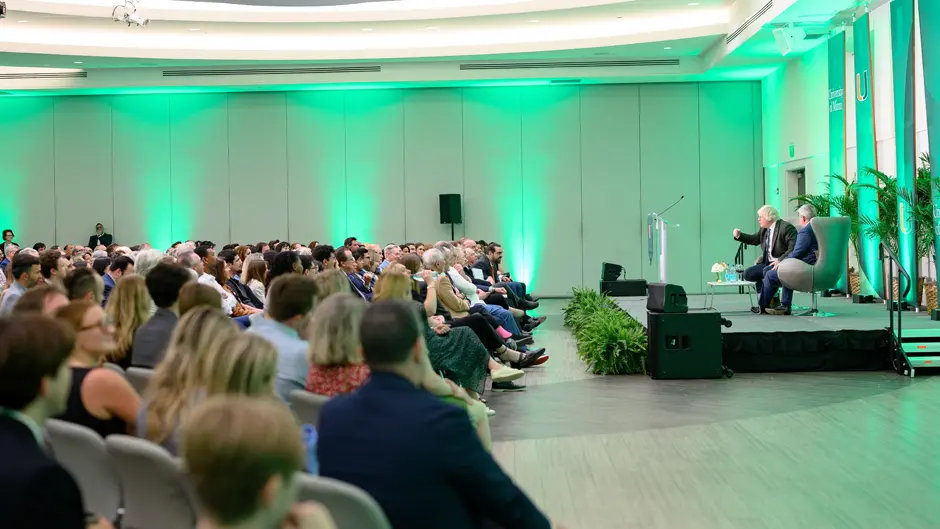 While Johnson and Samuels discussed serious topics, including the Russia-Ukraine War and lessons learned from the COVID-19 pandemic, their conversation also gave the audience a glimpse into Johnson’s sense of humor and his formative childhood experiences. Johnson talked about the sibling rivalries in his close-knit childhood home that gave him a competitive streak and how seeing his younger sister learn to read at an earlier age instilled in him a respect for girls that he brought to his role as foreign secretary.
“I became a feminist, in a way, very early on,” he said. “The thing that I really took away from my time as foreign secretary was that most development aid is completely wasted and pointless unless the men in the country concerned are teaching their daughters in the way that they are teaching their sons. We will not solve the problems of humanity until every young girl in the world has the same education as every boy.”
Samuels, a law professor and former dean of the University of South Carolina McCausland College of Arts and Sciences, also asked Johnson to share a decision he made during his public service career that he wishes he had approached differently.
Johnson shared his regrets about two conversations he had with Russian President Vladimir Putin in the weeks leading up to Russia’s 2022 invasion of Ukraine.
“I said this would be a disaster for him; it would be a disaster for the world; he shouldn’t do it,” Johnson recalled. “What I should have said, and what I really regret—and I think about it a lot—is: ‘If you do this, then you’ve got to understand that the West is going to support Ukraine, and we’re going to arm them, and we’re going to keep supporting them until they’re a free country.’
“I wish I had said that. I wish I had done much, much more to try to stop him,” Johnson added, explaining that at the time, he and his team believed Ukraine would not be able to withstand a Russian invasion.
During Johnson’s tenure as prime minister between 2019 and 2022, the U.K. provided Ukraine with significant military and humanitarian aid. Johnson has continued to advocate for a stronger European response to the Russia-Ukraine War, including in a recent op-ed published in The Wall Street Journal.
Toward the end of their conversation, Samuels read several questions submitted by members of the audience, including a question about how leaders can communicate the value of higher education amid a growing lack of confidence in the sector.
“I happen to think universities are great, great institutions and they’re homes of freedom and personal development and innovation,” Johnson said. “The role of leaders is to make that point.”
Johnson also talked about the book he’s currently writing, which delves into the relationship between Shakespeare’s works and the politics of the time.
Asked about his experience at the University of Miami, Johnson said he has had “the most wonderful time” and thanked Leonidas Bachas, dean of the College of Arts and Sciences, for introducing him to numerous faculty members.
“The staff and the faculty are incredible,” he said. “[Your students] have very, very sharp minds, and the questions they ask me are always good and to the point and sometimes quite challenging. It’s great.”