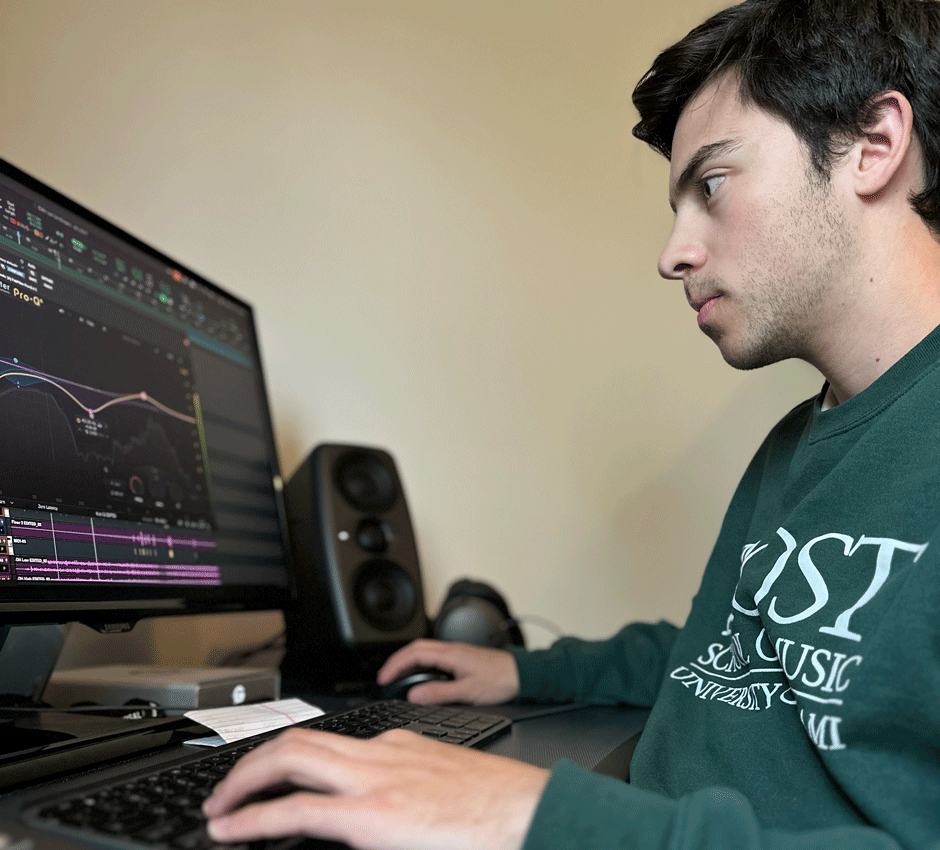
Growing up, Mike Lundy was no stranger to music. His mother is a professional harpist, while his father cultivated Lundy’s interest in contemporary music by sharing records of classic rock bands like Genesis, Pink Floyd, and Aerosmith.
Soon, Lundy decided he wanted to create his own music and began playing guitar. That interest in performing and working in the music industry continued through high school and led him to the University of Miami Frost School of Music, where Lundy is now starting his junior year as a music engineering major.
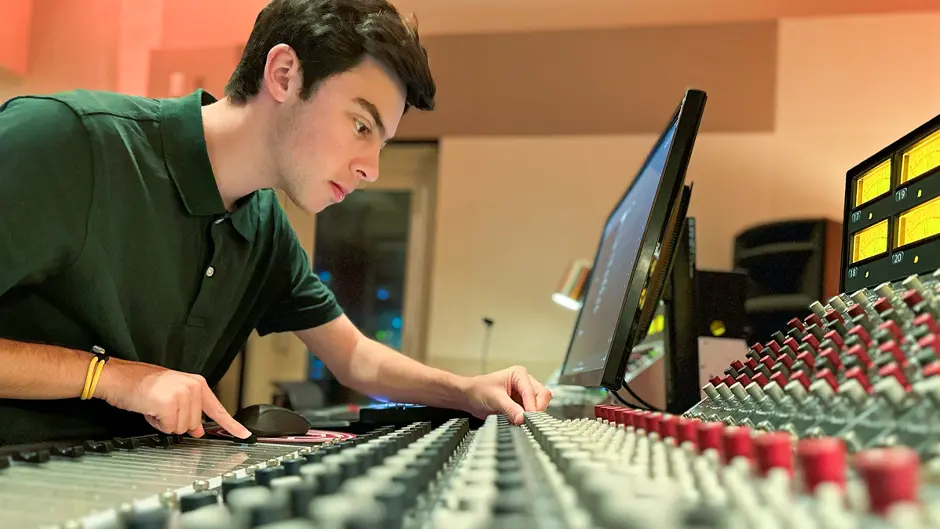
After graduation, he hopes to work in the music industry, but Lundy is not ruling out anything yet. This summer, he spent 11 weeks at Sweetwater Studios in Fort Wayne, Indiana as a music engineering intern. It was a big shift from Miami—or Lundy’s hometown of Washington D.C.—but the major music retailer and large studio complex allowed him to improve on his technical skills for studio work. He has also gotten the chance to record, mix, and get to know bands like Periphery, a metal group that is one of his favorites, as well as JJ Wilde, a Canadian singer. He also worked with several other artists and producers whom Lundy enjoys following.
“This is quite a dream come true,” he said, mentioning that he was thrilled to help record Periphery and even got backstage passes to their concert.
Lundy shared more about his summer experience below. His time at Sweetwater was also supported by a Mark and Maureen Angelo Family Endowment Fund scholarship that he applied for and received through the Toppel Career Center. This helped Lundy pay for many of his transportation and living expenses, he said.
How did you hear about this internship?
Sweetwater is a large music retail shop that does a lot of business online, so I’ve been a customer for at least a decade.
The studios have also been on my radar because a lot of my favorite bands record there. For example, Intervals is instrumental guitar along the heavy metal genre, and they recorded an album at Sweetwater Studios last year.
What motivated you to apply and to take the internship?
I’ve followed many of the Sweetwater music engineers online and on YouTube and learned from several of them before even getting to meet them, so it was a no-brainer to try and work with them. My boss was Shawn Dealey, who has been a mix engineer for the Counting Crows, and I learned to mix from watching him online, as well as Jason Peets, who is another great music engineer at Sweetwater. I’ve also gotten to talk with Nick Morzov, an engineer who worked with Animals as Leaders, and Blink-182, and Dealey has put me in touch with a lot of people who I really look up to in the industry.
Another bonus of this experience is that Sweetwater Studios are outfitted to record music in Dolby Atmos—a new format of immersive audio that gives it a three-dimensional feel. Music must be remixed for that format, and Sweetwater is at the cutting edge of studios mixing for this format. Shawn—my boss for the summer—does about 80 mixes a month in the format for bands that have included the Doobie Brothers and Steve Miller Band.
How does this fit into your broader career goals?
This internship has given me a great taste of what studio work is like. I picked Frost with the intention of working at a studio after college. Through the music engineering program and my work in the studios at the Frost School, I’ve gotten more technically interested in computer and software engineering.
Music engineering encompasses two areas. Working in the studio can include music editing, where I listen for certain notes and make digital notations, so that later we can make sure that all instruments are playing exactly in time with each other. I am also responsible for mixing, which generally means you’re creating a balance of all the instruments to deliver genre-appropriate results and quality music. What’s different about mixing is you are also responsible to make the music do what it’s intended to do or create a certain sentiment, so it’s more creative. For example, with aggressive metal music, as a mix engineer, you’re responsible for making that translate to the listener.
What was a typical day like?
If we are tracking a client in the studio, that involves early days to set up the studio. So, I put out microphones where they should go, wire up the studio, and set up the processors. Then, during recording sessions, I serve in an assistant engineering role, so if I see something going wrong, I’m out of my seat taking care of it. It can be up to 40 microphones for a drum kit. And it can be up to 60 microphones for a band. Some of those artists are here for weeks, while others record for a few days. We will leave the setup until the artist or band is done. Afterward, I have to restore the studio back to its initial condition.
If a smaller session is happening, I have taken on the role of editing the music. With Canadian artist JJ Wilde, during the recording, I was sitting in the lobby listening for certain notes. Then, later, we can make sure that all instruments are playing exactly in time with each other. This is pretty typical for most pop music, but it’s extremely time consuming and takes about 10 hours per song. There were 12 songs on the album, so it was a lot of work. They were quite long days, but I had a blast.
Did any University faculty or staff member help you with this process?
Frost associate professor Christopher Bennett was very supportive when I found the internship and helped me to navigate the interview process. He encouraged me to consider the studio work, and I am glad I did.
What’s irreplaceable about this experience?
Sweetwater offered me a unique opportunity because it’s a central music retailer, so there were many opportunities to meet people across the industry. Their business model is instead of having a bunch of stores nationwide, they have 1,000 sales reps that call people from their main headquarters in Indiana. To keep those salespeople up to date on the newest gear, music marketing firms partner with instrument companies to educate the salespeople. So almost every day, at least three different companies are here with new gear. I’ve met representatives from microphone companies, others who sell guitar pedals and amplifiers, as well as recording executives. So, working here and building those connections is a cool place to start. Also, any new gear that’s come out this summer I have seen just by walking upstairs, which is not something you can get at any other studio.