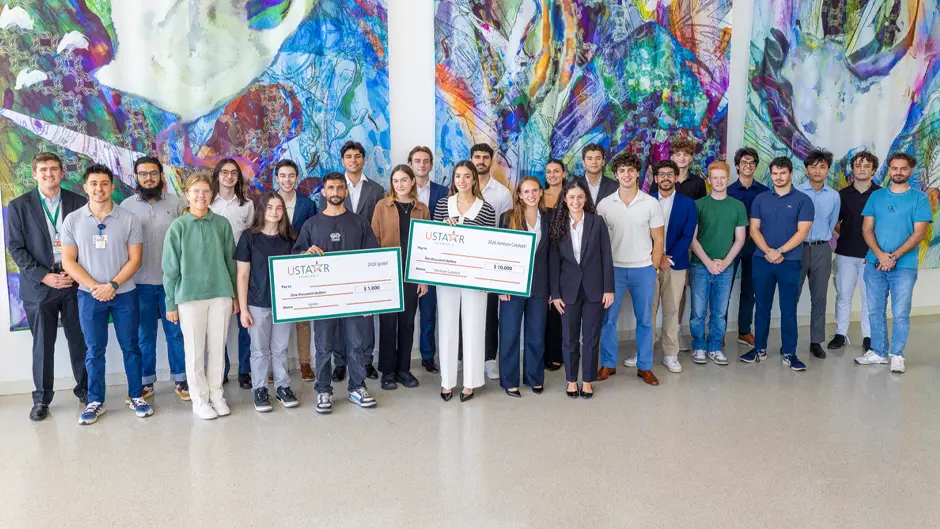
There was new software to help edit drum sequences and improve music quality, an AI- powered fish tank, and a tool to help doctors perform endoscopies quicker and safer.
But those were just three of 30 potential business innovations presented in lightning pitches at the University Student Startup Accelerator, or USTAAR kickoff event, this week.
As part of the program’s third cohort, 20 student teams received USTAAR Venture Catalyst awards of $10,000, along with mentoring to propel their concepts forward. Meanwhile, 10 other student teams received a $1,000 USTAAR Ignite awards to advance their business ideas. The teams were selected out of more than 90 applicants, and this spring, the teams will compete for five $100,000 investments from USTAAR that will enable commercialization and additional growth.
“At USTAAR, we believe in transforming ideas and concepts into products that drive socioeconomic impact in South Florida and beyond,” said USTAAR director Suhrud Rajguru, who is also a professor of biomedical engineering at the College of Engineering and otolaryngology at the Miller School of Medicine. “We are providing mentoring, capital, and resources to our student entrepreneurs, and the results in less than two years have been beyond what we could imagine.”
Started in 2024, USTAAR began with support from alumnus Angel Alvarez and his family to foster more student entrepreneurship on campus. Since then, the community of USTAAR award recipients has grown, many have started their own companies, and applicants are increasing by threefold, reflecting the innovative spirit at the University, Rajguru added.
Each student team that is awarded a catalyst award from USTAAR receives mentoring and support from staff members, many of whom are successful business leaders themselves. But USTAAR teams are also encouraged to seek guidance from the global Venture Mentoring team, and University partners such as The Launch Pad, the Office of Technology Transfer, the Cane Angel Network, and Orange Umbrella, a student-run advertising agency, and the Startup Clinic at the School of Law.
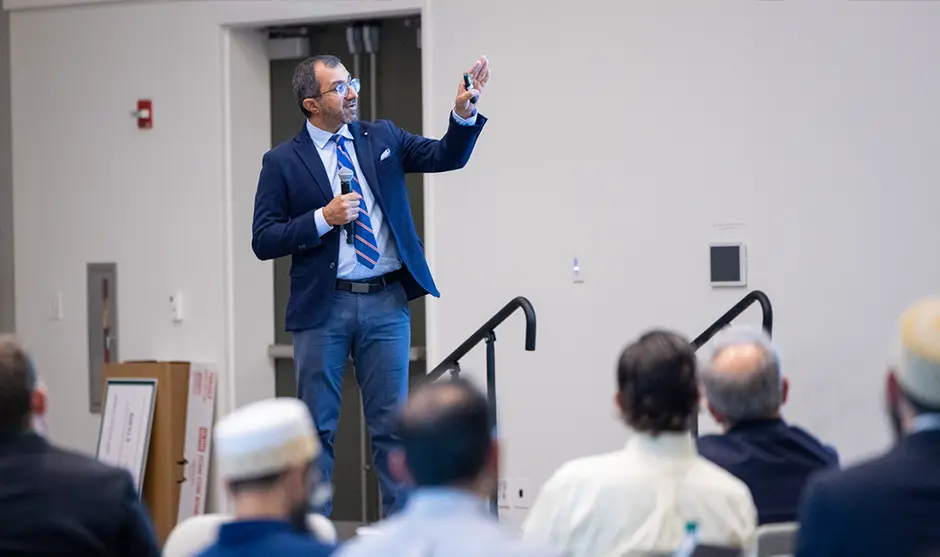
Rajguru also noted that this year’s awardees reflect the increased use of artificial intelligence (AI) in our everyday lives, as more than 40 percent of the proposed products utilize AI. At the kickoff event, Rajguru also highlighted a new and key partnership with Oracle and InfoLob. Guided by alumnus Adam Quintanilla, these partners will provide thousands of dollars in resources and product access, technical support, and White Glove Service to USTAAR entrepreneurs as they build and test their minimum viable products with Oracle’s AI platforms, Rajguru added.
Students receiving the USTAAR awards this week were thrilled. Jacey Snell, a junior studying music engineering at the Frost School of Music, presented her team’s product, Aligno, which she helped design with three of her music engineering classmates: Mike Lundy, Nico Russo, and Hanna Christensen. It is a tool for music producers and engineers to efficiently edit drums with improved onset detection with high accuracy.
“Getting this award is a huge step in our process, so that we can involve an AI model to get this project done faster and more efficiently than we could have even hoped for,” she said, adding: “We are all very excited.”
Meanwhile, Ashley Garcia a first-year student majoring in neuroscience, and Valentina Londono, a senior biochemistry major, were also happy to gain support for their idea. They are working with their siblings to create EndoAdvance, a tool to make it easier for gastroenterologists to feed some of the tubes involved in conducting an endoscopy, reducing the time involved in the procedure and lowering the patient’s risk of infection. The tool could also make the experience more efficient and comfortable for physicians.
“We are very optimistic with this funding but are also aware of the potential challenges later on,” Londono added. “We will spend the next few months refining and creating our prototype before the next pitch competition in March, so eventually this can be used in real life.”
A few of the other business teams include:
- Ulaw: An AI startup to help individuals quickly find a lawyer in their jurisdiction who is uniquely qualified to tackle their specific legal issue.
- Skinsmart: A skincare detection app that will help patients get a quick preliminary assessment of a skin lesion that may need a doctor’s attention, simply by patients taking images on their phone.
- Textile: An app to help families organize essential documents that need to be kept in a secure location and works without Wi-Fi in emergency situations.
- King Skin: An ointment that can heal chronic wounds in one to three weeks.
- Suisquia: The first AI-powered fish tank, allowing people to go on vacation while keeping their home aquarium thriving.
- Symbio Cinema: Creative and production services with AI integration offered to students and independent filmmakers, helping them tell stories that are often too costly to produce.
- Master Gear Garage: A business offering classes to teach younger generations how to repair classic cars.
For more information, visit the USTAAR website.