When Rhianna Taub finished her spring semester at Wayne State University in Michigan, she packed her bags for Coral Gables.
Once she arrived at the University of Miami, Taub delved headfirst into a project to map out cosmic structures in our solar system using an instrument called a spectrometer. She recently wrapped up two months studying astrophysics with professor Joshua Gundersen, whose research aims to better understand the Milky Way galaxy, where our solar system is located.
“This project will give us a better understanding of the history of our universe and will help us to see how its structure has changed over time,” Gundersen said.
A physics and astronomy major, Taub relished the opportunity to study astrophysics this summer and said she learned so much from Gundersen and his colleagues.
“I was seriously considering graduate school and getting the opportunity to work on astrophysics research daily has solidified that this is what I want to do,” Taub said.
She is one of eight undergraduate students from colleges across the country who spent most of their summer at the University’s Department of Physics at the College of Arts and Sciences, doing research with faculty members on topics such as the physics of tiny multicellular organisms as a model for human tissue, as well as refining some of the grounding equipment for a rocket that will take photos on future NASA space missions. Another nine students spent their summer at the College of Engineering, studying ways to make concrete more sustainable and durable, thanks to two separate Research Experiences for Undergraduates (REU) grants funded by the National Science Foundation.
Ideally, by hosting new undergraduates in their labs, faculty members hope some of these students will return to the University as graduate students or choose to enter the fields of physics or civil engineering, said Vivek Prakash, assistant professor of physics, who leads the physics program with professor Olga Korotkova.
“These students come here and learn how to do complex research, but they also bring different perspectives and their own techniques they have learned, so sometimes they help us come up with some pretty unique solutions,” said professor Ali Ghahremaninezhad, who leads the civil engineering REU. “Even the graduate students, who are mentors to these students, often learn from them, and we are thankful to have these fresh perspectives.”
Daniela Rivera, a senior studying civil engineering at the Polytechnic University of Puerto Rico, enjoyed spending time in Miami getting hands-on experience through several projects in Ghahremaninezhad’s Advanced Infrastructure Materials Research Lab.
She and many other undergraduates from the University and other institutions got a chance to work on novel forms of concrete composed with biochar, the burned remains of plants and seaweed. They also conducted experiments with different enzymes, including casein found in milk and others found in eggs, to determine if they could make concrete more durable. Another team of students worked on concrete containing hydrogels, the materials that absorb water in diapers. This can help create concrete that is less susceptible to erosion and cracking and ultimately lead to self-healing concrete. And another team worked with concrete that helps to absorb and purify water in areas that often flood.
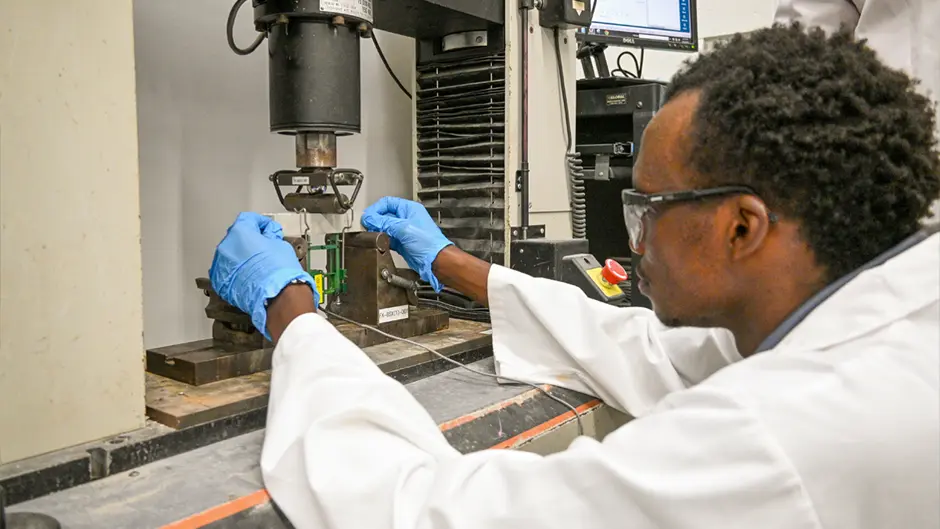
“I’ve gotten to learn and be exposed to intricate topics and challenged to try new things, which has helped me grow in terms of my problem-solving skills,” said Curtis Maeri, a sophomore studying mechanical engineering at the University. “I’ve also learned how to use different machines and equipment for different concrete strength and stress tests, which has been very interesting.”
Maeri and other students said they were fortunate to have a patient mentor in graduate student Farzad Rezaeicherati, who has taught them many of the techniques for testing and imaging new composite concrete. Others were led by Jasmine Rodriguez, who taught them how to create some of these composite concrete samples.
“We have noticed that you can see signs of healing from hydrogels in concrete as soon as day three,” said Hannah Chazbani, a third-year architecture student who worked in Ghahremaninezhad’s lab this summer. “This is interesting because you can see big differences between the different additives and biochar in concrete.”
A few buildings across campus, Eric Johnson, a senior from the College of William & Mary, worked on a project to isolate genetic tags in the nervous system of baby fruit flies that help them respond to colder and hotter temperatures. Since fruit flies are used as a simpler model for humans, the research could help explain how human brains respond to temperature and then signal other physical responses. He does this by utilizing a special laser that can isolate and manipulate neurons in the flies that are responsible for their behavior to temperature.
“I applied for this lab because I am interested in pursuing a Ph.D. in physics, but my school does not offer biophysics [or physics that involves animals],” said Johnson, who is working in associate professor Mason Klein’s lab, which is focused on biophysics. “I’ve been happy to do something different this summer.”
Maya Ryan, a rising senior from Willamette University in Salem, Oregon, was working in Kun Wang’s lab, which looks at finding alternative energy sources. She learned how to use a complex scanning and tunneling microscopy to explore the behavior of electrons in simple organic carbon molecules, and how the electron motion changes depending on the length of the molecules. Ryan said it was fascinating to work in a research lab, since there are only three physics professors at her college.
“It’s so nice to get access to well-funded labs and research,” she said.
Senior Jenna Coe agreed. She came from Syracuse University, where she is studying physics, and was working on understanding how Trichoplax, a simple multicellular organism, divides itself about every two days and how it changes in size through this process. The research may have applications for tissue engineering in the field of medicine later on, Prakash said.
Originally a biology major, Coe switched to chemistry and then later to physics and was glad to be combining her interests in Prakash’s lab this summer.
“I think I would like to continue in biophysics because there are a lot of different ways to use physics to study animals, and I never thought about that until I had this research experience,” she said.