The family vacation to the North Carolina Outer Banks during the COVID-19 lockdown was supposed to lift spirits. But it had rained almost every day, and Julia Van Etten was miserable and more than ready to return home.
“You brought your microscope along, why not collect just one sample before we head back,” her mother suggested. Though it was raining again, her mother stopped the car on the roadside, near a kayak push-off. Van Etten ambled out with her plankton net and saw that the marsh grass was crusty, a sign that there might be some unique microorganisms nearby. She scooped some of the brackish water into her sample jar.
Back home in New Jersey a few days later, Van Etten examined the sample under a microscope and realized instantly she had made a gem of a discovery: a new species of Paulinella, a photosynthetic amoeba that may well shed new light on how life was shaped on Earth millions of years ago.
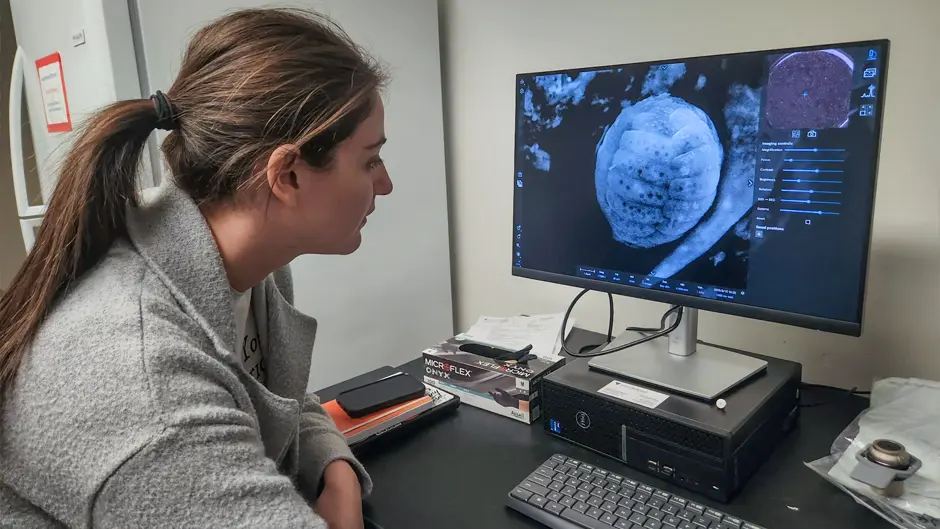
“Amidst all the brown and yellow, the diatoms and detritus and dirt, I saw something green that stood out—a lot of algae are green. I upped the magnification and saw this teardrop-shaped shell made of silica scales with these two semicircular-like tubes that are green inside,” Van Etten explained.
“It’s a tiny microbe, but I could see enough detail to know this has to be a Paulinella cell. My Ph.D. lab had done work on this organism, and I do so much microscopy that I know what I’m looking at—it was amazing,” she added.

Van Etten’s discovery was recently covered in a lengthy New York Times article. After her initial discovery, the University of Miami alumna, who earned her B.S. in marine science and biology in 2016, returned to the North Carolina site on multiple occasions where she later discovered a second Paulinella population.
She now leads a lab and teaches as an assistant professor at the University of Maryland. Van Etten has also created her own Paulinella Consortium for other labs, academics and science hobbyists to share research and sightings of the rare amoebae.
Born and raised in Scotch Plains, New Jersey, the daughter of a mother who dabbled in science and now works as a genetic counselor and her father a lawyer, Van Etten spent a lot of time at the beach. Her science epiphany though occurred as a 6-year-old stuck inside on a rainy afternoon.
“I was watching Animal Planet—as a kid I loved Steve Irwin—and he and wife Terri were on a boat, doing something special and interviewing a marine biologist,” she explained. “Sitting there on this horrible rainy day, I was just a kid but remember thinking: ‘That’s a job?’ After that it was like, ‘That’s what I’m going to do.’”
Even in middle school in New Jersey, Van Etten was aware of the University of Miami and its renowned marine biology program. When it came time for college, she and her dad visited “a bunch of schools,” then toured the University’s Coral Gables Campus and the Rosenstiel School of Marine, Atmospheric and Earth Science.
“Rosenstiel was on the beach. It was finals week, and there were hammocks all strung up on the main campus. It was like ‘Of course I’m going here,’” she remembered.
In her second semester, she began volunteering at the experimental hatchery on Virginia Key.
The sea slug was “hot” at the time, and everyone wanted to study it, so the only openings were to work with algae. Van Etten’s job was to optimize the growth of red macroalgae, or seaweeds, that were fed to the slugs.
Van Etten now has her own lab that conducts algae research. She volunteered at the hatchery for a year, then transferred to work with Athula Wikramanayake, now the biology chair in the College of Arts and Sciences, for her last two and a half years until graduation.
“It was awesome working with him, and I learned so much—all these molecular techniques because he works on sea urchins’ molecular development,” Van Etten noted. “He treated all the undergrads like grads; we had a lot of freedom to do some real experiments.
“The research questions professor Wikramanayake asked focused on early animal evolution but that got me thinking: ‘That’s really cool, but what happened before animals evolved?’”
That questioning initiated Van Etten’s trajectory as an evolutionary biologist, prompting her to think in deeper evolutional time and about protists, the work that she does now in her lab.
Van Etten took two years off after graduation, dabbling in hobby microscopy and reading popular science books such as Lynn Margulis’ books about endosymbiosis and how different microbes interact and feed off each other.
She bought a cheap $300 microscope and started going out, down the street from her home, collecting samples from puddles or wherever water pooled.
“I didn’t know what I was looking at first, but you figure it out. I started talking to people online and posting my findings on Instagram, and people started following and asking, ‘What is this?’
“I had to teach myself what everything was and why it was interesting, because all these microbes are super diverse. Some of them help us answer really important evolutionary questions. Some provide the oxygen we need to breathe, some are pretty, and some are really dangerous,” Van Etten noted. “That whole experience has formed the foundation of all the research I do now and a lot of the research I did in grad school.”
By the time she began graduate school at Rutgers University’s Ecology and Evolution Program, she had found her identity as an evolutionary biologist.
Immediately after her discovery in 2021, Van Etten called her doctorate advisor. “Oh my God, you won’t believe what I’ve found,” she stammered.
In large part owing to the advisor’s insistence, Van Etten returned to the Outer Banks site year after year for several years.
That little part of the marsh across from the motel has been a gold mine for her research.
“Every time I go to that spot I find a bunch of these cells. And they’re really hard to find,” Van Etten said. “I think these photosynthetic Paulinella cells are in most places, temperate to subtropical, and species have been found in fresh water, brackish and some marine spots.
“But they’re in such low abundance though that they’re hard to find—that’s a big question in the research I do: Why does a microbe that is in low abundance survive, why doesn’t it go extinct?” Van Etten said.
She’s humble about her findings and discovery.
“I am not the first person to find this organism. There are only six known species, and I described two new species this year,” she explained. “Paulinella is an incredible model for understanding primary endosymbiosis, but it’s not well studied yet. They’re hard to find, hard to grow and hard to isolate and sequence their genome.”
In lay terminology, how does she describe the importance of her discovery?
“Paulinella is an organism that created a new organelle from bacteria, and that’s a really rare and important process—it gave us all of the complex life and all of the algae we have on the planet,” she explained. “So, by studying this brand new type of algae called Paulinella, we could understand how those other events happened that gave us all the complexity of life we know.”